
How Long Does Investment Casting Take? Lead Times
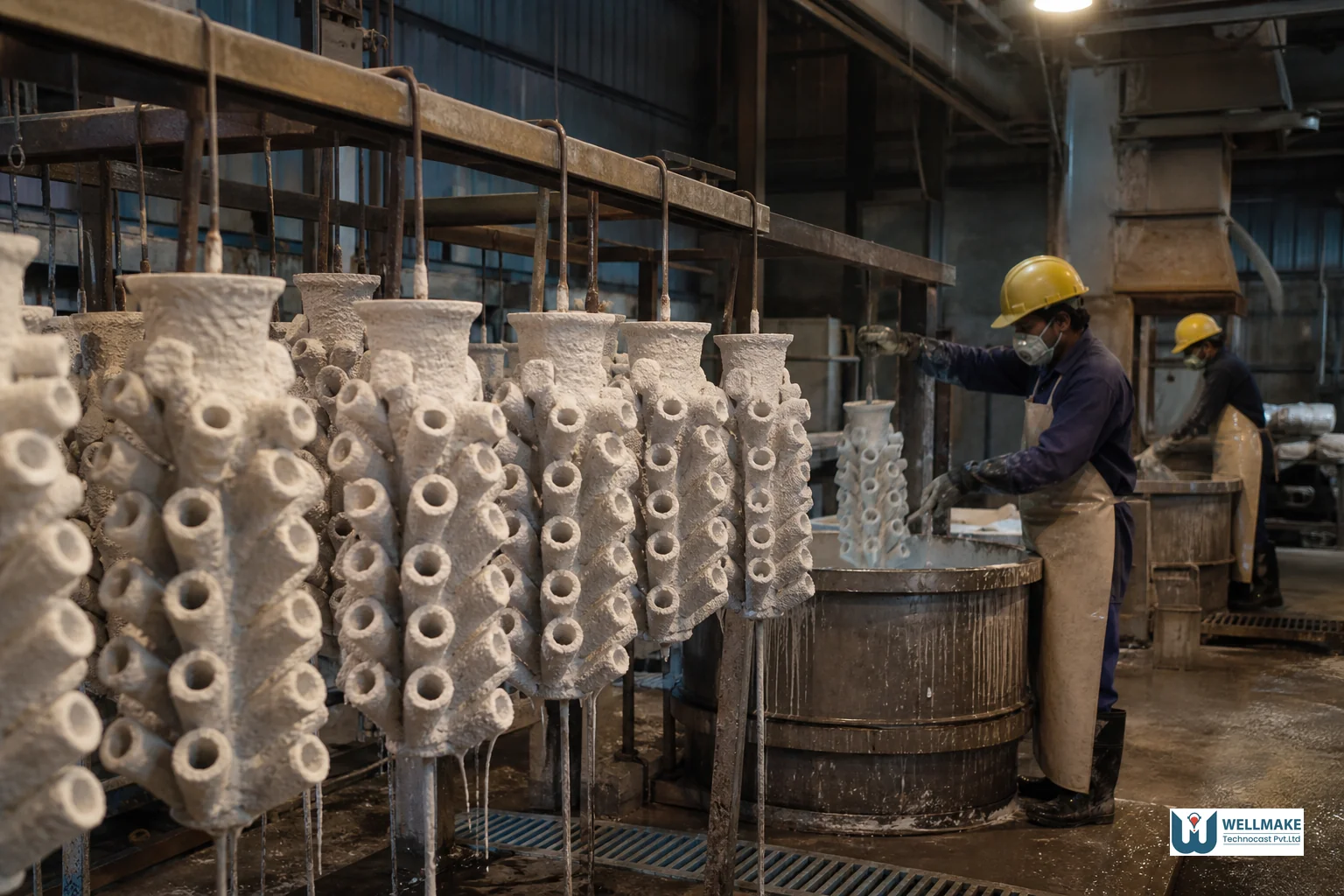
Investment casting typically takes 10 to 16 weeks for a new part with new tooling, and 3 to 6 weeks for a repeat order on existing tooling, depending on alloy, complexity, and batch size. The variable most buyers overlook is not the pour itself, it's the ceramic shell building and machining stages that sit on either side of it.
Key Takeaways
- New tooling programs run 10-16 weeks: from design approval through first article inspection, before serial production even begins.
- Repeat orders ship in 3-6 weeks: because tooling, first article approval, and process validation are already done.
- Shell building alone takes 5-8 days: ceramic dip coats need controlled drying time between layers and cannot be rushed without risking cracked shells.
- Alloy, wall thickness, and machining scope drive most schedule swings: a duplex stainless valve body with tight tolerances will always take longer than a simple carbon steel bracket.
- A rolling forecast shared with your foundry protects your production line: blanket orders and scheduled call-offs smooth furnace loading and cut effective lead time.
At a Glance: Investment Casting Lead Times by Stage
| Production Stage | New Tooling Order | Repeat Order | Main Time Driver |
|---|---|---|---|
| Tooling design & manufacture | 4-8 weeks | Not required | Part complexity, cavity count |
| First article inspection | 1-2 weeks | Not required | Dimensional approval cycles |
| Wax pattern production | 3-5 days | 2-4 days | Batch size, tree assembly labor |
| Ceramic shell building | 5-8 days | 5-8 days | Humidity-controlled drying cycles |
| Dewaxing, casting & knockout | 2-4 days | 2-4 days | Alloy pour temperature, furnace scheduling |
| Finishing & machining | 1-3 weeks | 1-2 weeks | Machining scope, heat treatment |
| QC, packing & dispatch | 3-5 days | 3-5 days | Inspection load, export documentation |
| Total (before freight) | 10-16 weeks | 3-6 weeks | Combination of all above |
Why Investment Casting Lead Time Is Rarely a Single Number
Ask three foundries how long investment casting takes to produce, and you'll likely get three different answers, none of which mean quite the same thing. One quotes from tooling approval. Another quotes from raw material availability. A third quotes only the casting cycle itself and leaves machining and freight as someone else's problem to estimate.
That inconsistency is the real pain point for procurement teams. A quoted "6-week lead time" is meaningless if it excludes the four weeks it actually takes to cut tooling, or the two weeks a part sits waiting for CNC machining capacity. What buyers actually need is dock-to-dock time: the full span from purchase order signature to the part landing at their facility, ready to use.
Understanding each stage of the process changes how you plan. It also changes how you negotiate schedules and evaluate whether a foundry's quoted timeline is realistic or optimistic. The rest of this guide walks through every stage investment casting production actually involves, so you can build a procurement schedule that holds up under real-world conditions rather than best-case ones.
For a full walkthrough of what happens at each stage, see our detailed breakdown of how investment casting works step by step.
1. Tooling and Die Design: The First Bottleneck
For any part that hasn't been cast before, tooling is where the clock really starts. A die needs to be designed, machined, and trialed before a single wax pattern can be injected. For a moderately complex component, this typically takes 4 to 8 weeks, depending on the number of cavities, whether slide-action or collapsible cores are needed, and how much back-and-forth happens during design review.
Multi-cavity dies producing several parts per injection cycle take longer to build but pay off on larger orders. Simple single-cavity tools for prototype runs can sometimes be ready in three to four weeks. Complex tooling with moving cores for undercuts or internal passages, common in pump and valve bodies, can stretch past eight weeks.
Once the die is cut, the foundry runs a trial shot and produces a first article for dimensional inspection. This adds another 1 to 2 weeks before the tool is formally approved for production. Buyers planning a new part launch should treat tooling and first article approval as a distinct project phase, not a footnote inside the overall lead time. For a detailed cost breakdown of this stage, see our guide on investment casting tooling costs.
2. Wax Pattern Production and Assembly
Once tooling is qualified, wax pattern injection itself moves quickly. Each shot takes only a minute or two, but the real time sink is downstream: workers assemble individual wax patterns onto a central sprue to form a "tree," check for flash or surface defects, and repair any imperfections by hand before the tree moves to shell building.
For a typical production batch, this stage takes 3 to 5 days. Larger batches with many patterns per tree take longer to assemble but are more efficient per piece once shell building begins, since each shell dip coats an entire tree of parts at once rather than a single component.
3. Ceramic Shell Building: The Hidden Time Sink
This is the stage most buyers underestimate, and it's usually the real reason a "fast" quote turns out to be unrealistic. Each wax tree is dipped repeatedly into ceramic slurry and coated with refractory sand, building up a shell strong enough to survive molten metal. A typical shell needs 5 to 7 dip coats, and each coat needs controlled drying time in a humidity- and temperature-regulated room before the next layer goes on.
Skipping or rushing drying time causes shells to crack or develop porosity-inducing defects once metal is poured. That's why full shell building typically takes 5 to 8 days from first dip to final coat, regardless of how urgent an order is. No amount of overtime labor speeds up a drying cycle governed by chemistry and climate control.
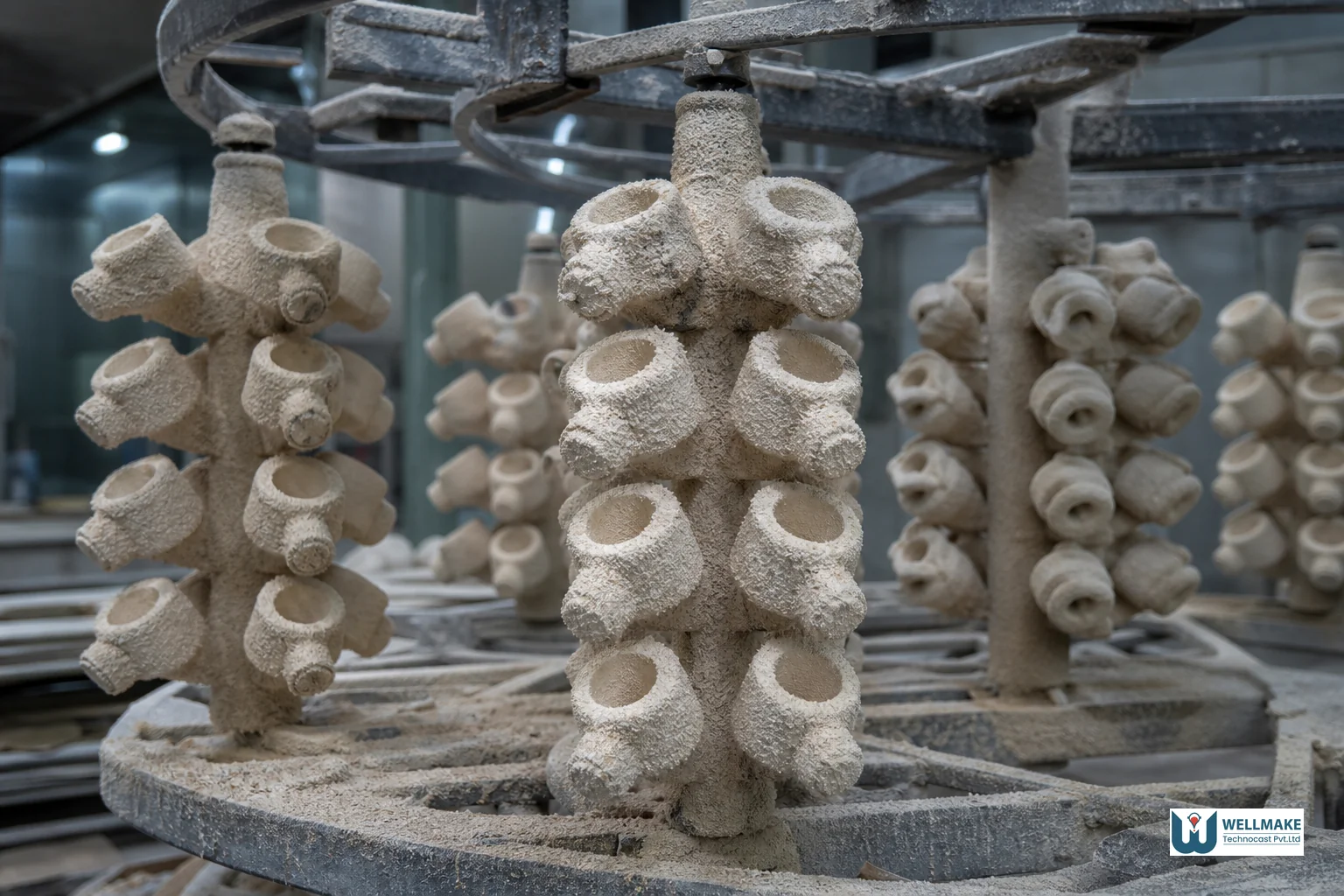
This is worth explaining to internal stakeholders who assume a foundry can simply "add more shifts" to compress a schedule. Shell building is the one stage where patience genuinely protects part quality, and reputable foundries won't compress it just to hit an arbitrary date.
4. Dewaxing, Casting, and Knockout
Once shells are fully built and dried, they go through an autoclave or flash-fire dewaxing process that melts out the wax pattern, leaving a hollow ceramic mold. Shells are then fired to full strength and moved to the pour floor, where they're filled with molten metal timed against the foundry's furnace batch schedule.
Pour temperature and cooling time vary meaningfully by alloy. Carbon and low-alloy steels cool relatively quickly. Duplex and super-duplex stainless steels, along with nickel-based alloys used in oil and gas or aerospace applications, require more controlled cooling to avoid microstructure defects. After cooling, shells are broken away in the knockout stage, a process that itself takes 1 to 2 days for cleaning and initial inspection before parts move to finishing.
5. Finishing, Machining, and Quality Control
Raw castings still need gates and risers cut off, surfaces ground smooth, and in many cases heat treatment to achieve specified mechanical properties. For components that need to be line-ready rather than shipped as rough castings, CNC machining adds a further 1 to 3 weeks, depending on how many features need to be machined and how tight the tolerances are.
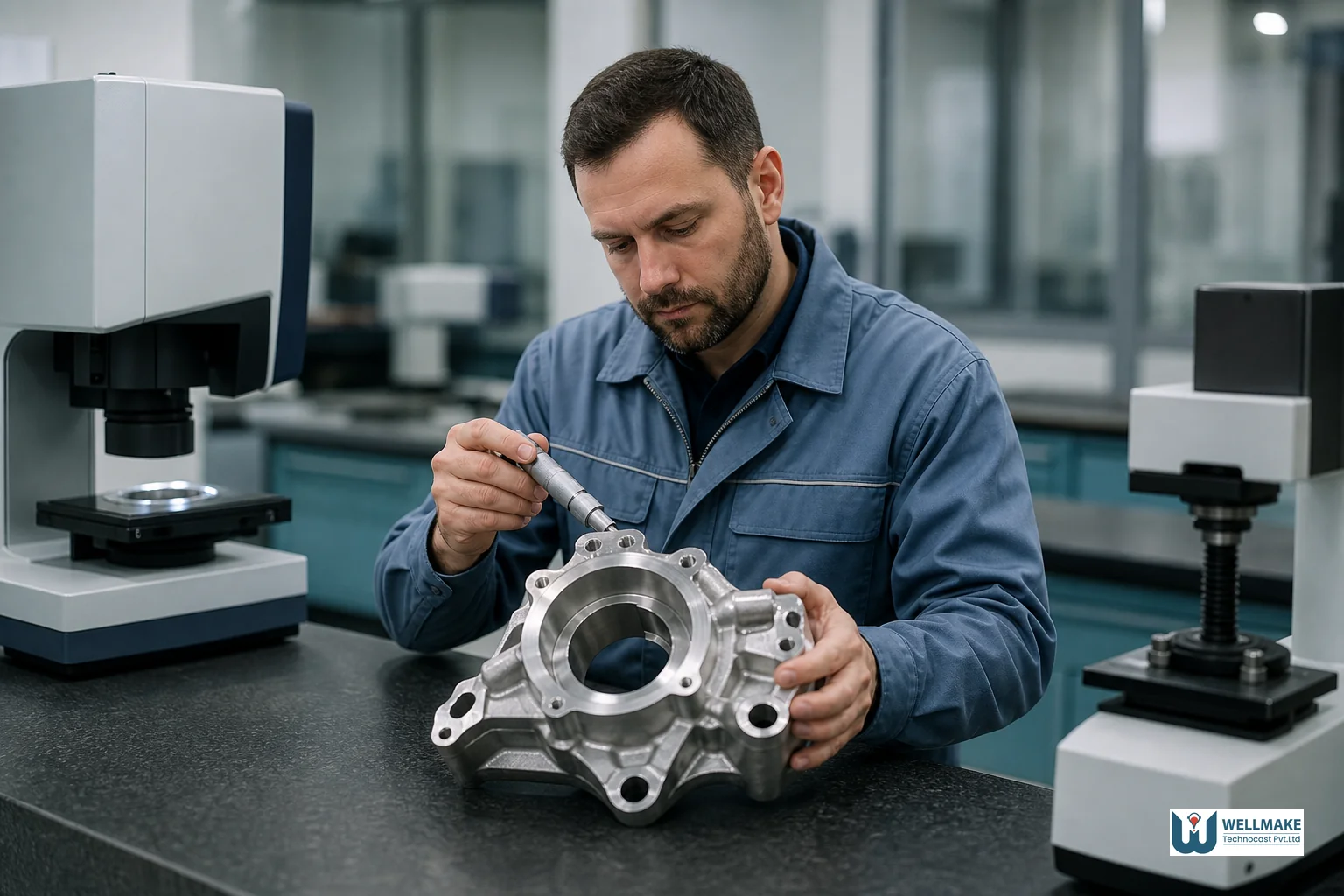
Before any part is released, it should pass through in-house quality control: spectrometer analysis to confirm chemical composition, hardness testing, and in many cases impact testing for structural applications like railways and defence components. Skipping this step to save time is exactly the kind of shortcut that leads to field failures downstream. If you're unsure what tolerances and finishes are realistic for your application, our guide on choosing the right investment casting foundry covers what to check before you commit to a supplier.
New Tooling vs. Repeat Orders: Comparing Timelines
The gap between a first-run order and a repeat order is the single biggest lead-time variable buyers deal with, and it's often misunderstood during initial sourcing conversations. Once tooling exists and a part has passed first article inspection, an enormous portion of the schedule simply disappears.
| Stage | First Production Run (New Tooling) | Repeat Order (Existing Tooling) |
|---|---|---|
| Tooling design & trial | 4-8 weeks | Skipped entirely |
| First article inspection | 1-2 weeks | Skipped entirely |
| Wax through shell building | 8-13 days | 7-12 days |
| Casting, knockout & finishing | 2-4 weeks | 2-3 weeks |
| QC & dispatch prep | 3-5 days | 3-5 days |
| Typical total | 10-16 weeks | 3-6 weeks |
Buyers who place a single order and then wait to reorder from scratch effectively pay the tooling penalty every time. A better approach is a blanket purchase order with scheduled release dates, which lets the foundry plan furnace batches around your forecast rather than starting each order as an isolated event. This is one of the most overlooked levers for shrinking effective, felt lead time without changing the physical process at all.
Factors That Extend or Shorten Lead Time
Several variables push a quoted timeline up or down, and it helps to know which ones are within your control as a buyer.
- Alloy type: Carbon and low-alloy steels move through melting and cooling faster than duplex stainless steels or nickel-based superalloys, which need tighter temperature control and sometimes additional heat treatment cycles.
- Part complexity and wall thickness: Thin walls, internal cavities, and tight tolerance zones require more careful shell design and can extend both shell building and machining time. Our post on investment casting vs forging for oil and gas applications looks at how geometry complexity affects manufacturing route selection.
- Order volume: Very small batches sometimes wait to be combined with other trees on the shell-building schedule, while very large batches may need to be split across multiple furnace pours, both of which affect the realistic ship date.
- Machining and secondary operations scope: The more machined features, coatings, or assembly steps required, the more this stage adds to total time. Buyers can shorten this by qualifying a supplier who handles both casting and machining in-house.
- Regional holidays and seasonal demand: Indian foundries typically schedule around festival periods like Diwali, and global demand spikes (year-end budget flushes, fiscal year-end orders) can extend queue times at any foundry, not just in India.
- Freight mode: Sea freight from India to Europe or North America typically adds 3-5 weeks to the production lead time, while air freight can cut this to days but at a materially higher cost. Factor this into your total dock-to-dock calculation, not just the factory-gate ship date.
How to Plan Procurement Schedules Around Casting Lead Time
Once you understand where the weeks actually go, procurement planning becomes a scheduling exercise rather than a guessing game. A few practical habits make a measurable difference:
- Build a rolling 12-month forecast and share it with your foundry rather than issuing single, disconnected purchase orders. This lets the foundry pre-book furnace capacity and raw material against your actual demand curve.
- Use blanket orders with scheduled call-offs instead of reordering from zero each time. This keeps tooling active and avoids restarting the qualification clock.
- Qualify your supplier before you need capacity, not after a production ramp is already behind schedule. Our guide on how to qualify an overseas investment casting supplier covers the audit steps worth doing early, and our related piece on red flags to avoid when sourcing from a foundry flags the warning signs that predict late deliveries.
- Ask for a written production schedule with milestone dates, not just a single promised ship date. A credible foundry can show you when tooling trial, first article, shell building, and pour are each expected to complete.
- Build in buffer for first-time orders with any new supplier or new alloy, even if the quoted timeline looks tight. First-run surprises are common, and a two-week buffer costs far less than a stalled assembly line.
These habits matter across sectors, whether you're sourcing pump and valve components in Sweden, aerospace parts in Canada, or railways and defence parts in the UK. The physics of shell building and casting don't change by region, but the supply chain risk of a late shipment does, especially for regulated industries with certification and audit trail requirements.
Why Wellmake's 70 MT Monthly Capacity Matters for On-Time Delivery
Lead time reliability depends as much on a foundry's spare capacity as it does on the physics of shell building. A foundry running at full furnace utilization has no room to absorb a rush order or recover from a shell-building delay without pushing every other customer's schedule back. Wellmake Technocast operates a 70 MT monthly production capacity from its Rajkot, Gujarat facility, casting components from a few grams up to 180 kg in both ferrous and non-ferrous alloys, which gives real headroom for scheduling flexibility rather than running every order at the edge of capacity.
Process discipline matters just as much as raw capacity. Wellmake's ISO 9001, ISO 14001, and ISO 45001 certifications reflect documented, repeatable procedures at every stage, from wax injection through shell building, casting, and final inspection using in-house spectrometers, hardness testers, and impact testing equipment. That documentation is what makes a quoted delivery date something you can actually plan a production line around, rather than a rough estimate that shifts once the order is confirmed.
Because machining and quality control happen in-house rather than being outsourced to a third party, there's one less handoff, and one less place where a schedule can quietly slip. Wellmake serves OEMs and engineering firms across automotive, aerospace, pump and valve, oil and gas, mining, railways, defence, and fire safety sectors worldwide, working from the same production discipline whether the order is a prototype batch or a multi-ton monthly release schedule.
If you're evaluating options beyond a domestic supplier, our comparison of India-based casting versus local foundry sourcing for Australia walks through how lead time, cost, and quality control trade off across regions, a useful reference regardless of where your facility is based.
Frequently Asked Questions
How long does investment casting take for a first prototype?
A single prototype using rapid or 3D-printed patterns instead of a hard tool can sometimes be produced in 2 to 4 weeks, since it skips die manufacturing entirely. However, prototypes made this way may show minor process differences from tooled production parts, so it's worth confirming with your foundry whether a rapid prototype is representative enough for your qualification needs.
Can lead time be shortened with rapid tooling or 3D printed patterns?
Yes, for low-volume or prototype orders. 3D-printed wax-like patterns remove the 4-8 week die manufacturing stage, letting a foundry move straight to shell building. This isn't typically used for high-volume production, where hard tooling remains more cost-effective and dimensionally consistent across thousands of cycles.
Does order volume change the lead time per piece?
Yes, but not always in the direction buyers expect. Very small orders sometimes wait longer because they get grouped with other trees to fill a shell-building batch efficiently. Very large orders may need to be split across multiple furnace pours. Discussing your expected volume upfront helps a foundry plan a batch schedule that avoids both extremes.
How far in advance should I place a purchase order?
For a new part on new tooling, plan for a 10 to 16 week lead time minimum before you need parts on your production line, plus freight time. For repeat orders on qualified tooling, 4 to 8 weeks including freight is a safer planning window than assuming the shortest quoted figure will hold every time.
A realistic lead time isn't a single number on a quote. It's the sum of tooling, shell building, casting, machining, and freight, each of which has its own physical limits that no amount of urgency can compress.
Understanding exactly how long investment casting takes to produce is the first step toward a procurement schedule that doesn't leave your production line waiting. If you're planning a new part launch or want to compare tooling and repeat-order timelines against your current supplier, explore Wellmake's product range to see the alloys and component categories produced at their Rajkot facility. For a detailed schedule specific to your part geometry, alloy, and volume, get in touch with Wellmake's engineering team to build a milestone-based production plan before your next purchase order goes out. Reliable lead times start with asking the right questions early, and Wellmake's team is ready to walk through your specific timeline requirements when you contact us today.