
How Does Investment Casting Work? Step-by-Step
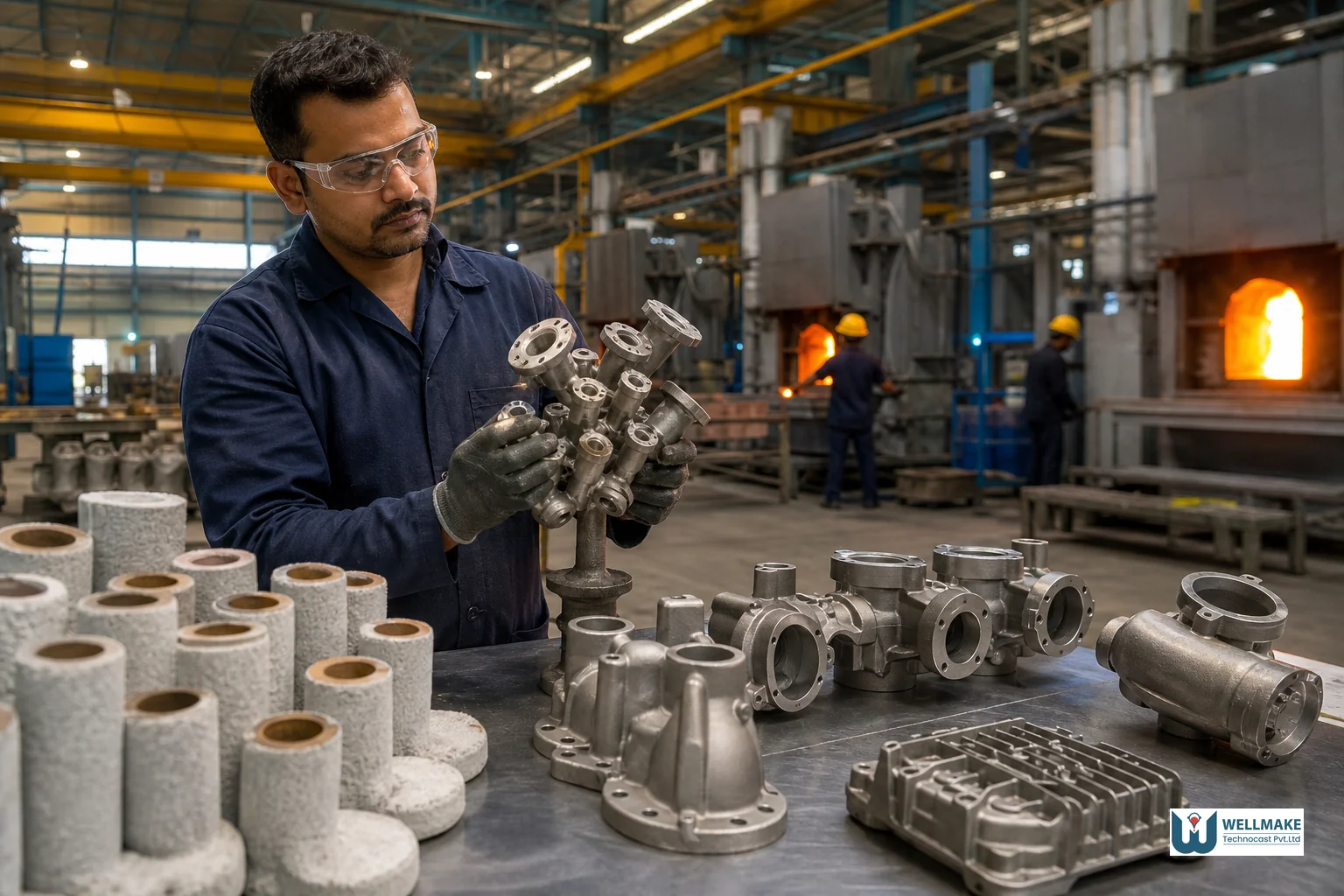
A valve body drawing lands on a foundry engineer's desk. It has a curved internal passage, a wall as thin as 3mm in one section, and a tolerance callout that leaves almost no room for error. The engineer doesn't reach for a lathe or a sand mold. She reaches for wax. That single choice, wax instead of metal as the starting shape, is the reason investment casting can produce geometries that machining and sand casting simply cannot match.
If you're an OEM or procurement lead evaluating cast components, understanding what the investment casting process looks like step by step isn't just technical curiosity. It tells you exactly where dimensional accuracy is built in, where defects can creep in, and which questions to ask a supplier before you commit tooling budget. This guide walks through Wellmake's 8-step process in the order it actually happens on the foundry floor.
What Is Investment Casting? A Quick Definition
Investment casting, also called lost-wax casting, is a manufacturing method where a wax replica of a part is coated in ceramic to form a mold, then melted out ("lost") before molten metal is poured into the resulting cavity. The technique dates back thousands of years, used originally for jewelry and sculpture, and has since become the standard for producing complex, high-precision metal components in industries from pump and valve manufacturing to aerospace and defence.
What sets it apart from sand casting or die casting is the starting pattern material. Wax can be molded into fine detail, thin walls, and internal passages that would be impossible or extremely costly to machine from solid bar stock. The result is a near-net-shape part that often needs little or no secondary machining, which is why so many buyers compare it directly against investment casting cost per kg versus other production routes before making a sourcing decision.
The Investment Casting Process Step by Step
Every reputable foundry, including Wellmake's facility in Rajkot, Gujarat, follows a version of the same 8-stage sequence. Skip a step, rush it, or execute it inconsistently, and the defect shows up later, sometimes only after machining, when it's far more expensive to fix. Think of the 8 steps less as a checklist and more as a chain: each link determines what tolerance and surface finish the final part can actually achieve.
1. Tooling and Wax Pattern Creation
The process starts with a metal die, usually aluminum, machined to the exact negative shape of the finished part, including allowances for shrinkage that occurs as the metal cools. Molten wax is injected into this die under pressure, then cooled and ejected as a solid wax pattern that is a near-perfect replica of the component.
This tooling is a one-time investment that gets amortized across every part produced from that die afterward, which is why order volume matters so much for per-piece pricing. Buyers who want the full financial picture, including how die complexity, cavity count, and material affect upfront cost, can review our breakdown of what drives investment casting cost per kg for a more complete comparison.
2. Assembling the Wax Pattern Tree
A single wax pattern rarely goes into the furnace alone. Instead, multiple patterns are attached by hand to a central wax sprue, forming what the industry calls a "tree." Depending on part size, a tree might carry anywhere from a handful of large components to over a hundred small ones.
Clustering patterns this way isn't just about convenience. It maximizes furnace utilization, keeps energy consumption per part lower, and allows a foundry to pour dozens of identical components in a single cycle with consistent metallurgical properties. For high-volume pump, valve, and automotive components, this assembly stage is where production efficiency is largely decided.
3. Building the Ceramic Shell
The wax tree is dipped repeatedly into a ceramic slurry, then coated with fine sand (called stucco), and left to dry. This cycle, dip, stucco, dry, repeats between five and nine times depending on part size and the shell strength required. Each layer adds thickness and rigidity, and the combination of coats determines how well the mold will hold its shape once the wax is removed and molten metal is poured in.
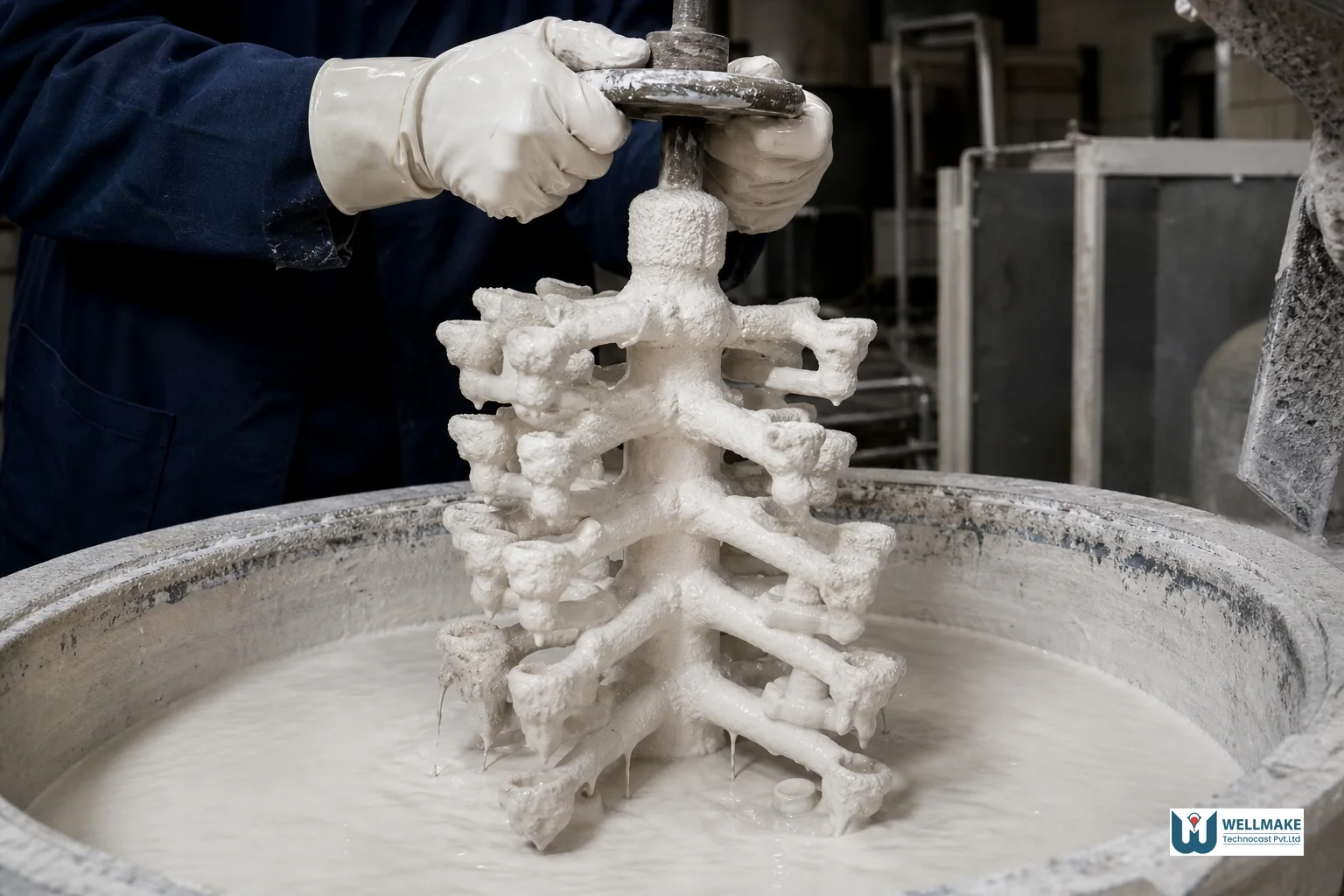
Shell thickness and coat consistency directly affect dimensional stability and surface finish. A shell that's too thin can crack under molten metal pressure; one applied unevenly can distort the final geometry by fractions of a millimeter, which matters enormously when a customer's drawing calls for tight positional tolerances. This is one of the process stages where experience and quality discipline separate reliable foundries from inconsistent ones.
4. Dewaxing (Wax Removal)
Once the ceramic shell has fully cured, it goes into a steam autoclave or a flash-fire oven at high temperature. The heat melts the wax, which drains out through the sprue opening, leaving behind a hollow ceramic mold that is an exact negative of the original part geometry.
Well-run foundries reclaim and filter this wax for reuse in future patterns, reducing both material cost and waste, a practice that fits within Wellmake's broader commitment to sustainable manufacturing using renewable energy and waste recycling across its production lines.
5. Shell Firing and Preheating
Before any metal touches the mold, the ceramic shell is fired at high temperature. Firing burns off any residual wax or moisture and further strengthens the ceramic structure so it can withstand the thermal shock of molten metal. In most cases, the shell is kept hot, or preheated again just before pouring.
Preheating matters because it keeps the metal fluid longer as it fills the cavity, which is essential for parts with thin walls, fine detail, or long flow paths. Skip this step or run it inconsistently, and you risk incomplete fills, cold shuts, or porosity, defects that only surface during pressure testing or machining much later in the supply chain.
6. Pouring the Molten Metal
Metal is melted in an induction furnace to the required alloy specification, with chemistry verified by spectrometer analysis before the pour. This step is non-negotiable for sectors like oil & gas, defence, and pump & valve manufacturing, where alloy composition directly affects corrosion resistance and mechanical performance under load.
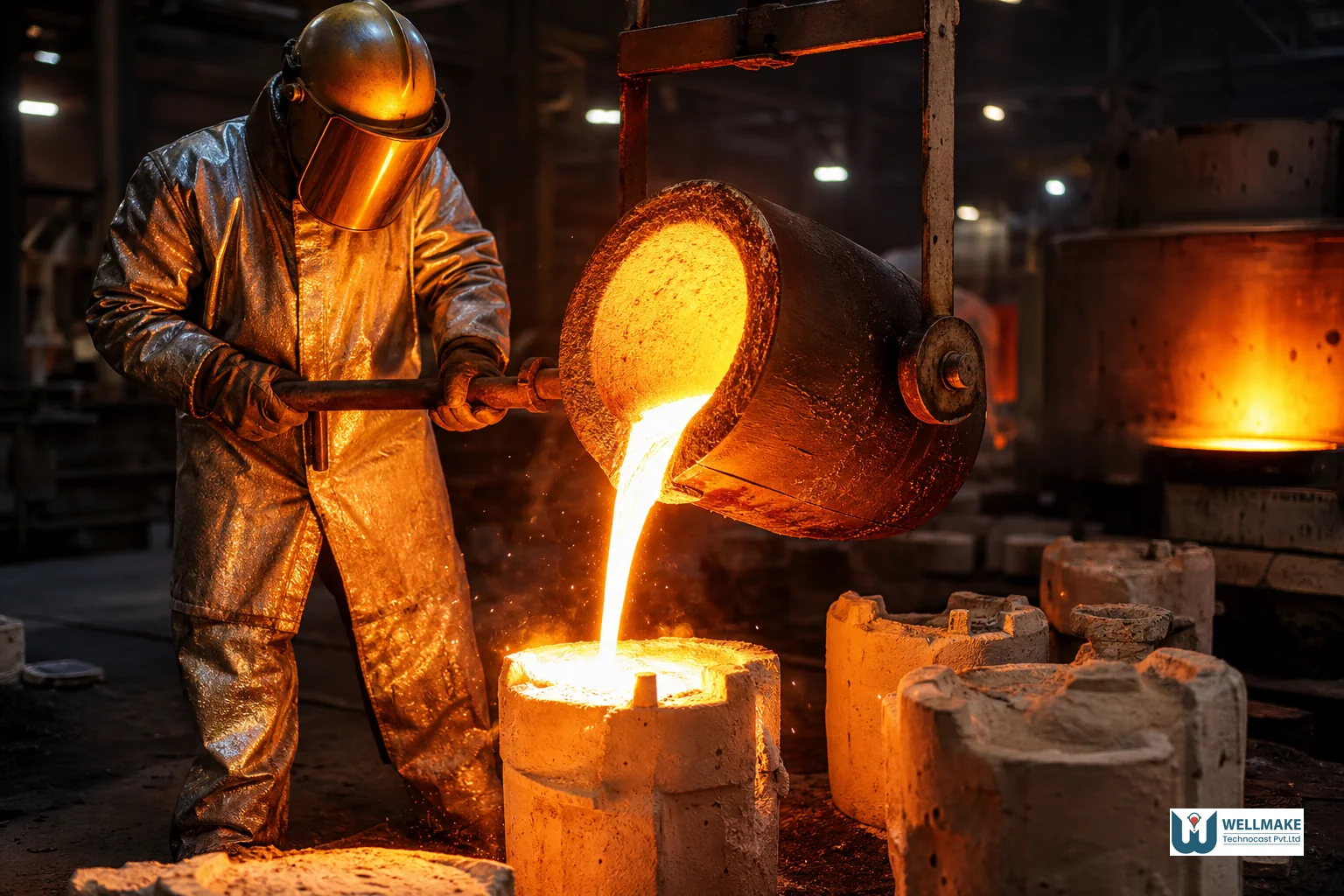
Once chemistry is confirmed, the molten metal, whether carbon steel, stainless steel, ductile iron, or a non-ferrous alloy like bronze or aluminum, is poured into the still-hot ceramic shell. Gravity and, in some cases, vacuum or pressure assistance help the metal reach every cavity, including thin sections and intricate internal features that would be unreachable with conventional casting or bar-stock machining.
7. Shell Removal and Cutoff
After the metal solidifies and cools, the ceramic shell is broken away using mechanical vibration, knock-out hammers, or high-pressure water blasting. What remains is a metal tree with individual castings still attached at their gates, essentially a rough metal skeleton of the original wax assembly.
Each casting is then cut from the tree, usually with a band saw or abrasive wheel, and the leftover gate stub is ground flush with the part surface. At this point the component already closely resembles its final form, a direct result of how faithfully the wax pattern replicated the design back in step one.
8. Finishing, Machining, and Quality Inspection
Raw castings typically go through heat treatment to achieve specified mechanical properties, followed by shot blasting to clean the surface and remove any remaining ceramic residue. From there, parts that require tighter tolerances than as-cast finish allows move to CNC machining, which is where Wellmake's capability to deliver line-ready, fully machined components (not just raw castings) becomes valuable to OEMs who want a single source for both stages.
Before any component ships, it passes through in-house quality control: spectrometer verification of chemical composition, hardness testing, impact testing, and dimensional inspection using coordinate measuring equipment against the original drawing. This is the checkpoint where a foundry either confirms every earlier step was executed correctly, or catches a problem before it reaches your production line.
Why This Process Achieves Tolerances Other Methods Cannot
Sand casting molds are built from compacted sand, which has a coarser surface texture and looser dimensional control than a ceramic shell built around a precision wax replica. Die casting can hold tight tolerances but is largely limited to non-ferrous metals like aluminum and zinc, and struggles with the internal geometries that investment casting handles easily. Machining from solid bar stock can achieve excellent tolerances too, but it wastes significant material and adds substantial labor cost on complex shapes, something buyers researching investment casting sourcing options in mature markets like Germany often discover when comparing quotes side by side.
Because the mold in investment casting is built directly around a precise wax pattern rather than a reusable metal die or packed sand, it can reproduce fine surface detail, thin walls, and internal channels in a single pour. That translates into as-cast tolerances that are frequently tighter than what sand casting can achieve straight out of the mold, with far less post-cast machining required to get there.
What Materials Can Go Through This Process
Investment casting supports a wide range of ferrous and non-ferrous alloys, which is part of why it serves so many industries from a single manufacturing method:
- Carbon and alloy steels — used widely in general engineering and automotive components
- Stainless steel grades (304, 316, 17-4PH and others) — common in pump & valve, oil & gas, and fire safety hardware where corrosion resistance is critical
- Ductile and grey iron, used in railway and heavy industrial components requiring strength and wear resistance
- Bronze and brass, favored in architectural hardware and marine applications
- Aluminum alloys, chosen where weight reduction matters, including select aerospace and automotive applications
The right alloy depends on the operating environment, load requirements, and any regulatory certifications the end application demands, particularly in defence, aerospace, and oil & gas sectors where material traceability is often mandatory.
Frequently Asked Questions About the Investment Casting Process
How long does the full 8-step process take?
A complete cycle, from wax injection through final inspection, typically takes anywhere from a few days to a few weeks depending on part complexity, shell build requirements, and whether post-cast machining is needed. Simpler components with fewer ceramic coats move faster; large or highly detailed parts requiring more shell layers and secondary machining take longer.
Can investment casting handle both very small and very large components?
Yes. The process scales well, with capable foundries producing parts from a few grams up to well over a hundred kilograms. Wellmake's production capability, for example, spans components from a few grams to 180 kg within its 70 MT monthly capacity, covering everything from small pump fittings to substantial valve bodies and structural castings.
Do all foundries follow exactly the same 8 steps?
The core sequence, wax pattern, tree assembly, shell building, dewax, fire, pour, shell removal, finishing, is standard across the industry. What varies significantly between foundries is execution quality at each stage: shell consistency, alloy chemistry control, and the rigor of in-house testing. That variation is exactly why qualifying a supplier properly matters as much as understanding the process itself.
What quality checks should matter most when qualifying a supplier?
Look for spectrometer verification of alloy chemistry, mechanical testing (hardness and impact), dimensional inspection against your drawing tolerances, and certifications like ISO 9001 for quality management. Foundries that also hold ISO 14001 and ISO 45001 demonstrate environmental and safety management maturity, which often correlates with more disciplined process control on the shop floor.
Sourcing a Foundry That Executes Every Step Right
Understanding the 8 steps is useful, but the real value comes from knowing which foundry executes each one consistently, pour after pour, tree after tree. A single rushed dip in the ceramic shell stage or an unverified alloy pour can turn into a rejected batch weeks later, after your team has already invested engineering time reviewing the parts.
Wellmake Technocast has run this exact 8-step process from its Rajkot facility since 2005, backed by ISO 9001, ISO 14001, and ISO 45001 certifications and in-house testing equipment including spectrometers, universal testing machines, and impact testers at every stage of production. With 70 MT of monthly capacity serving automotive, pump & valve, oil & gas, aerospace, railways, defence, and fire safety manufacturers across global markets, the company builds precision into the process rather than inspecting for it afterward.
If you're evaluating investment casting for an upcoming component, start by reviewing the range of parts and materials Wellmake produces, or explore the full product range to see examples across ferrous and non-ferrous castings. For a specific drawing, tolerance requirement, or material question, get in touch with Wellmake's engineering team to discuss how the process applies to your part. Whether you need raw castings or fully machined, line-ready components, contact us today to start the conversation before your next production run.