
Investment Casting for Pump & Valve Makers in Sweden
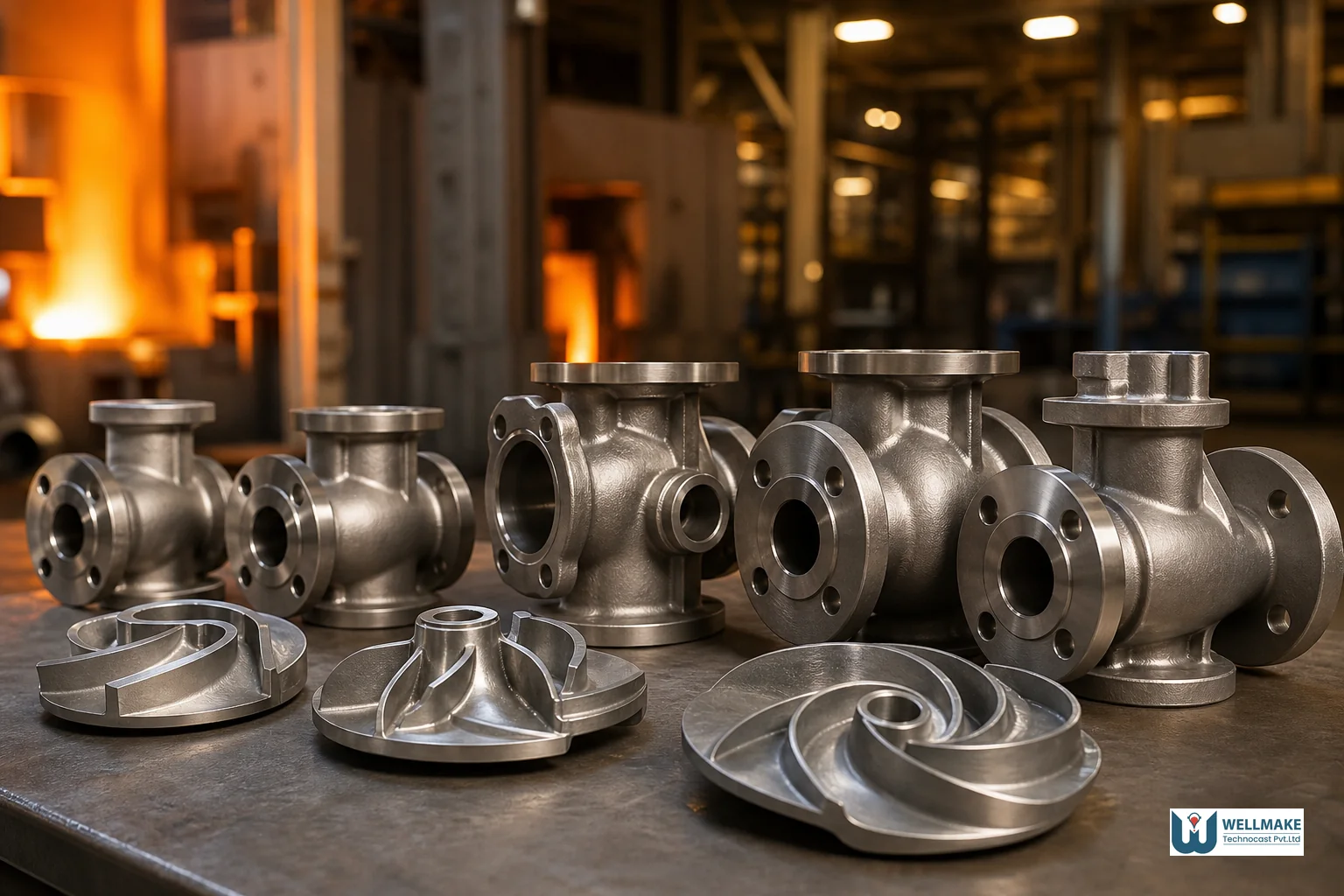
A design engineer at a valve assembly plant outside Gothenburg recently spent three weeks waiting on a quote for a batch of duplex stainless steel valve bodies. The local foundry she'd used for a decade had shut two shifts due to energy costs. Her backup supplier in Germany was booked six months out. She wasn't looking for a cheaper option. She was looking for a supplier who could actually deliver on time without sacrificing the tolerances her pressure-rated parts demanded. That search is becoming common across Sweden's pump and valve sector, and it's exactly why investment casting for pump valve manufacturers Sweden has turned from a niche sourcing question into a mainstream procurement conversation.
Sweden's industrial base, anchored by well-known names in pumps, valves, and fluid handling equipment, depends on a steady flow of precision cast components. Impellers, volutes, valve bodies, bonnets, and seat rings all demand tight dimensional control and clean internal geometry. When domestic and regional foundry capacity tightens, manufacturers need a sourcing method that holds up under scrutiny: consistent metallurgy, verifiable quality documentation, and a process built for complex shapes. This guide walks through exactly what to expect from investment casting as a sourcing solution, how the process works from wax pattern to finished part, and how to evaluate an overseas foundry partner against the standards Swedish buyers already hold their local suppliers to.
Why Swedish Pump & Valve Makers Are Rethinking Their Casting Supply Chain
Sweden's fluid handling manufacturers operate in a demanding environment. Energy costs across Northern Europe have squeezed foundry margins, and several smaller Nordic casting houses have reduced shifts or closed entirely over the past few years. That leaves fewer local options for the complex, mid-volume castings that pump and valve production depends on. At the same time, buyers still need to meet EN and ISO material standards, maintain traceability for pressure equipment, and hit delivery windows tied to their own customers' project schedules.
These pressures are pushing procurement teams to widen their supplier search beyond Sweden's borders. Overseas foundries with strong quality systems and export experience are stepping into that gap, particularly in India, where investment casting capacity has grown alongside international certification standards. The goal isn't to abandon quality expectations. It's to find a process and a partner that can match or beat local benchmarks on tolerance, material integrity, and reliability, while easing the cost and capacity pressure Swedish manufacturers are feeling.
1. Define the Component Requirements Before You Source
Before requesting a single quote, get specific about what the part actually needs to do. Pump and valve components live in demanding service conditions: high pressure, abrasive media, corrosive fluids, or extreme temperatures. A sourcing decision made without a clear technical brief almost always leads to rework later.
- Pressure class and media compatibility: Note the working pressure, temperature range, and the fluid or gas the component will handle, since this determines alloy selection.
- Critical dimensions and sealing surfaces: Flag which surfaces need tighter tolerances, particularly valve seats, gasket faces, and bearing bores.
- Wall thickness and internal geometry: Note any thin sections, curved internal passages, or undercuts that would be difficult or costly to machine from solid stock.
- Delivery form: Decide whether you need an as-cast (un-machined) component or a fully machined, line-ready part ready for assembly.
- Applicable standards: Reference the relevant EN, ASTM, or ISO material and dimensional standards your end customer requires.
Having this brief ready before you contact a foundry speeds up quoting and lets you compare suppliers on an apples-to-apples basis. It also becomes the reference document for the first article inspection later in the process.
2. Understand What Investment Casting Delivers for Pump & Valve Components
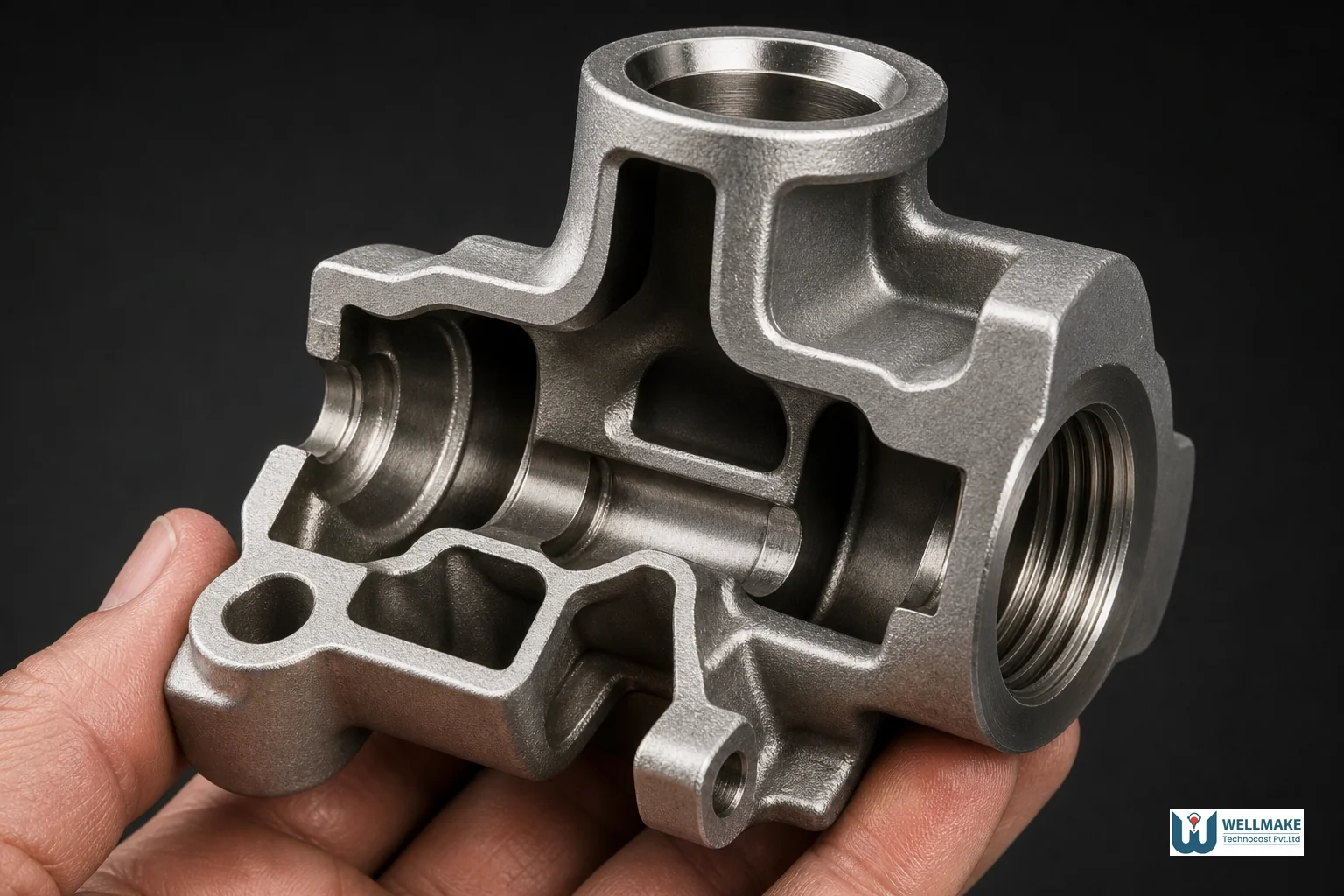
Pump and valve bodies are some of the most geometrically demanding parts in industrial manufacturing. Volutes curve internally to manage flow. Valve bodies need smooth, uninterrupted bores for sealing. Impellers require vane profiles that would be nearly impossible to machine economically from a solid billet. This is exactly the kind of geometry investment casting was built to handle.
Unlike sand casting, which struggles with fine detail and tight tolerance, or machining from bar stock, which wastes material and adds cost on complex shapes, investment casting produces near-net-shape parts directly from a wax pattern. The result is a component that already carries much of its final geometry before it ever touches a machine tool. The step-by-step investment casting process explains the mechanics in detail, but for pump and valve applications, three advantages stand out.
Complex Geometry Without Compromise
Investment casting reproduces curved flow passages, thin walls, and internal cavities in a single pour. That means volute housings, multi-port valve bodies, and vaned impellers can be produced as one piece rather than assembled from welded sections, which improves structural integrity and reduces leak paths.
Tighter Tolerances, Less Machining
Because the ceramic shell process captures fine detail directly from the wax pattern, cast parts typically arrive within tolerances that reduce the amount of stock removal needed downstream. That translates into shorter machining cycles and less scrapped material compared to machining from forged blanks or solid bar. Buyers should still confirm exact tolerance capability against their drawing, since choosing the right foundry often comes down to whether they can consistently hold the tighter tolerance bands your seating surfaces require.
Material Versatility for Demanding Service
Pump and valve components see a wide range of alloys depending on the media and pressure class: austenitic and duplex stainless steels, carbon and low-alloy steels, nickel-based alloys for corrosive service, and bronze or aluminum alloys for lighter-duty applications. A capable investment casting foundry should be able to pour and heat-treat all of these to the mechanical properties your specification calls for.
3. Follow the Process: Wax Pattern to Line-Ready Machined Part
Understanding the production sequence helps you ask better questions during supplier evaluation and set realistic delivery expectations. A well-run investment casting operation follows roughly eight stages, moving from a single wax pattern to a finished, inspected component.
- Tooling and wax pattern injection: A die produces a wax replica of the finished part, built to account for shrinkage during solidification.
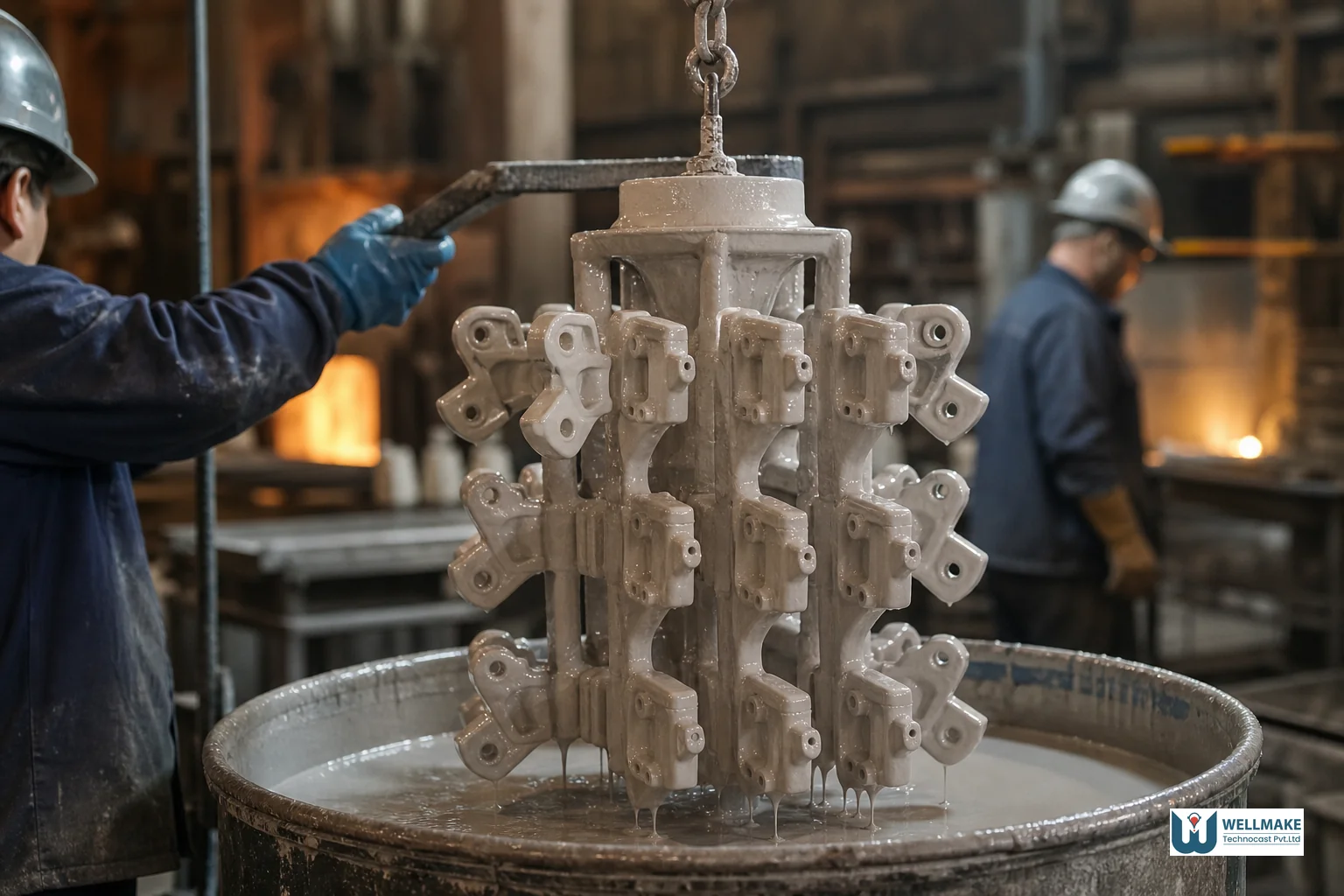
- Pattern assembly: Multiple wax patterns are attached to a central sprue, forming a "tree" that allows several parts to be cast in one cycle.
- Ceramic shell building: The tree is repeatedly dipped in ceramic slurry and stuccoed with refractory sand, building up a hard shell layer by layer.
- Dewaxing: The shell is heated so the wax melts and drains out, leaving a hollow ceramic mold.
- Pouring: Molten metal, matched to the specified alloy, is poured into the preheated shell under controlled conditions.
- Shell removal and cut-off: Once cooled, the ceramic shell is broken away and individual parts are cut from the tree.
- Heat treatment and finishing: Parts undergo grinding, heat treatment, and surface finishing to meet mechanical property and cosmetic requirements.
- Machining and final inspection: Line-ready components move to CNC machining for critical dimensions, followed by dimensional and material inspection before shipment.
A foundry that offers in-house machining alongside casting, rather than outsourcing that step to a third party, gives you a single point of accountability for the entire part. That matters when a sealing surface tolerance is off by a few microns and you need one supplier, not two, to own the fix.
4. Evaluate an ISO-Certified Indian Foundry Partner Against Swedish Standards
Swedish procurement teams are used to holding suppliers to strict documentation and compliance standards, and that expectation shouldn't change just because the supplier is overseas. When evaluating an Indian investment casting foundry, look for the same rigor you'd expect from a European Union-based supplier.
- Management system certifications: ISO 9001 for quality management, ISO 14001 for environmental management, and ISO 45001 for occupational health and safety are the baseline. A foundry holding all three signals a mature, audited operation rather than one built around a single certificate for marketing purposes.
- In-house testing capability: Spectrometer analysis for chemical composition, universal testing machines for tensile strength, hardness testing, and impact testing all indicate the foundry can verify its own output rather than relying on external labs for every batch.
- Documentation package: Confirm the foundry provides material test certificates (MTCs), dimensional inspection reports, and, where applicable, radiographic or dye-penetrant test records tied to each batch.
- Environmental alignment: Swedish and broader EU buyers increasingly weigh supplier sustainability practices in procurement decisions. Ask about energy sourcing, water recycling, and waste management at the foundry.
Wellmake Technocast, based in Rajkot, Gujarat, holds ISO 9001, ISO 14001, and ISO 45001 certification, backed by in-house spectrometer, UTM, hardness, and impact testing equipment. That combination lets Swedish buyers verify material and dimensional compliance without waiting on third-party lab turnaround, which shortens the qualification cycle considerably.
5. Benchmark Quality, Lead Time, and Cost Against Local Alternatives
Cost comparisons between local Nordic foundries and overseas investment casting suppliers need to go beyond the per-piece quote. A complete benchmark should weigh four factors together: unit price, tooling investment, freight and logistics, and total lead time from order to dock.
Unit Price and Tooling
Indian investment casting foundries generally offer lower per-kilogram pricing than Western European counterparts, driven by labor cost differences and scaled production capacity. Tooling costs for wax injection dies are a one-time investment that gets amortized over the production run, so it's worth reviewing what actually drives investment casting cost per kilogram before comparing quotes side by side, since alloy selection, part complexity, and machining scope all move the number more than the country of origin does.
Freight and Total Landed Cost
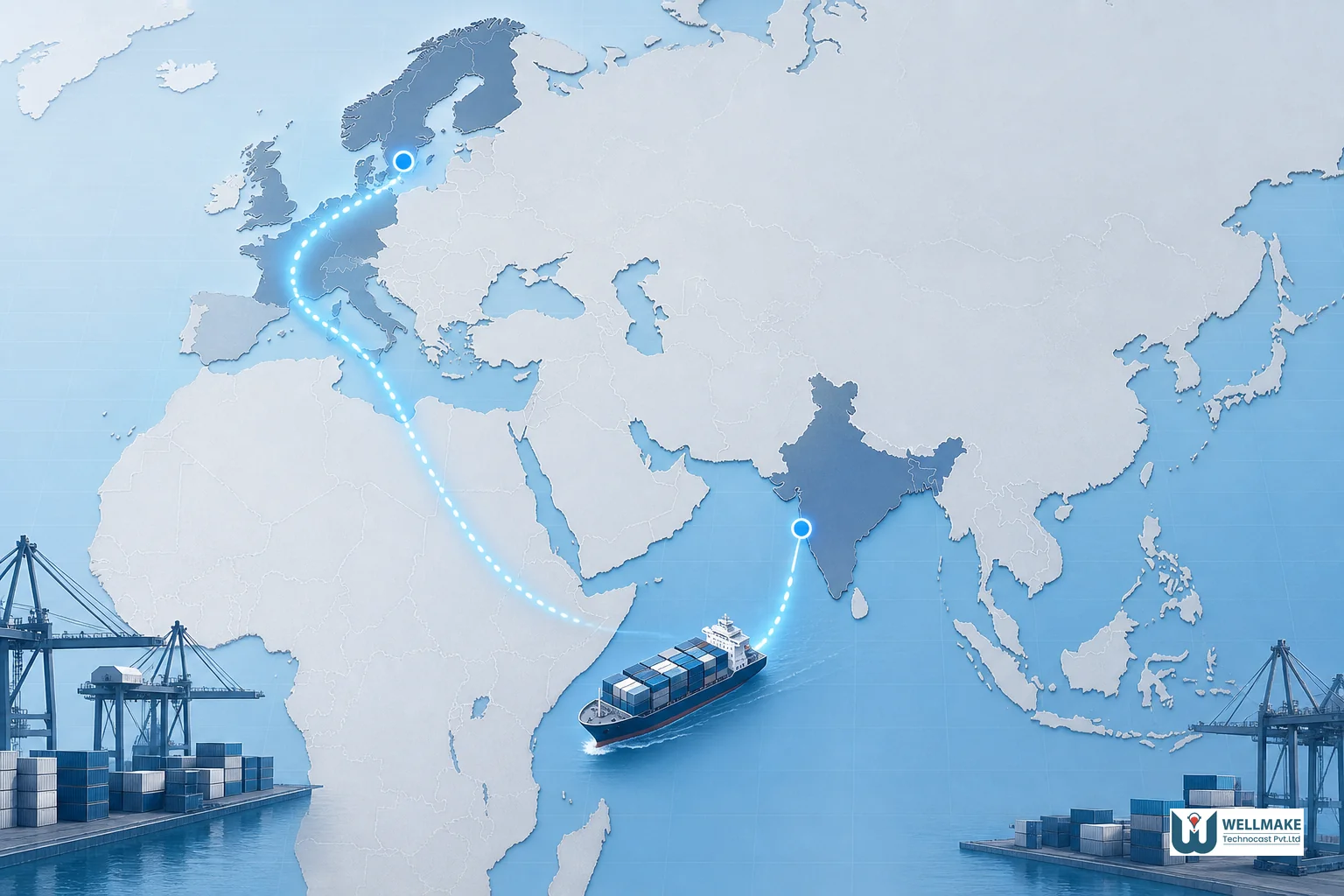
Sea freight from Indian ports to Swedish or Northern European destinations typically adds several weeks to the timeline compared to a domestic supplier, but the freight cost per part is usually small relative to the unit price savings on mid-to-large volume orders. Building this into your total landed cost model, rather than comparing ex-works prices alone, gives a more accurate picture of the real savings.
Lead Time Planning
A realistic overseas casting order runs through tooling, production, finishing, machining, inspection, and shipping. Buyers should ask for a documented lead time breakdown for each stage rather than a single combined number, since that transparency makes it easier to plan around your own production schedule and to hold the supplier accountable if a stage slips.
MOQ Considerations
Minimum order quantities affect the economics of switching suppliers. Foundries with flexible MOQs make it easier to run a smaller qualification batch before committing to full-volume production, which reduces risk for a first-time overseas sourcing decision.
6. Watch for Red Flags When Qualifying an Overseas Casting Supplier
Not every foundry that claims export experience actually delivers it consistently. A few warning signs are worth flagging early, before a contract is signed.
- No traceable material certification: If a supplier can't provide batch-specific material test certificates tied to heat numbers, treat that as a serious gap.
- Vague or shifting lead times: Suppliers who won't commit to a stage-by-stage schedule, or who quietly extend delivery dates without explanation, tend to cause the most disruption downstream.
- No first article inspection process: A foundry unwilling to run a formal first article inspection against your drawing before full production is a sign of weak internal quality control.
- Inconsistent communication: Slow, unclear, or inconsistent responses during the quoting stage often carry through to the production stage.
- Limited export documentation experience: Customs paperwork, certificates of origin, and packaging standards suited to long sea transit all matter for a smooth delivery to Sweden. A supplier new to export shipments may underestimate this.
These patterns are worth building into a formal supplier checklist rather than relying on gut feel during a single call. Many procurement teams find it useful to walk through a structured audit before placing a first order, an approach covered in more depth around the general principles of how to choose the right investment casting foundry.
7. Run a Structured Supplier Qualification and Trial Order
Once you've shortlisted a foundry, resist the urge to jump straight to full-volume production. A staged qualification process protects your supply chain and builds confidence on both sides.
- Request a first article sample: Have the foundry produce a small batch against your finished drawing, including any machining and surface finish requirements.
- Run a full dimensional and material audit: Compare the sample against your tolerance callouts and material specification, using your own inspection equipment or a third-party lab if needed.
- Review documentation quality: Check that the material test certificate, dimensional report, and any NDT records are complete, legible, and traceable to the batch.
- Place a trial production order: Start with a smaller batch that mirrors your actual production volume before committing to a long-term contract.
- Set a review checkpoint: Agree on a formal review after the first two or three shipments to confirm consistency before scaling up further.
This staged approach applies equally whether you're sourcing valve bodies, pump casings, or impellers, and it gives your engineering team a documented basis for approving the supplier internally, which matters when quality assurance sign-off is required for pressure equipment components.
Frequently Asked Questions
What materials can be cast for pump and valve components?
Common alloys include austenitic and duplex stainless steels, carbon and low-alloy steels, nickel-based alloys for corrosive or high-temperature service, and bronze or aluminum for lighter-duty applications. The right alloy depends on the media, pressure rating, and temperature range the part will see in service.
How long does an export order from India to Sweden typically take?
Total lead time depends on tooling requirements, part complexity, and order volume, but a typical cycle covers tooling development, casting production, finishing, machining, inspection, and roughly three to five weeks of sea freight to Northern European ports. Requesting a stage-by-stage schedule from your supplier gives a more accurate project timeline than relying on a single quoted number.
Can a foundry deliver fully machined, line-ready parts rather than just raw castings?
Yes, many established investment casting foundries, including Wellmake Technocast, offer in-house CNC machining so components arrive ready for assembly rather than requiring a separate machining supplier. This reduces the number of vendors in your supply chain and keeps quality accountability with a single partner.
What is a reasonable minimum order quantity for pump and valve castings?
MOQs vary by part size, complexity, and tooling requirements. Foundries with flexible production scheduling can often accommodate smaller qualification batches before scaling to full production volumes, which is worth confirming during initial supplier discussions.
How does investment casting compare to forging or machining from bar stock for valve bodies?
Investment casting typically wins on complex internal geometry and material utilization, since it produces near-net-shape parts with minimal waste. Forging can offer higher strength for certain load cases but struggles with intricate internal passages. Machining from bar stock is often the least efficient option for complex shapes due to material waste and longer cycle times. The right choice depends on the specific pressure class, geometry, and volume of your component.
Move Your Casting Supply Chain Forward
Swedish pump and valve manufacturers don't need to choose between quality and reliability when local foundry capacity tightens. A structured approach, defining component requirements clearly, verifying certifications and testing capability, benchmarking true landed cost, and running a staged qualification process, makes it possible to bring an overseas investment casting partner into your supply chain with confidence rather than guesswork.
Wellmake Technocast has spent nearly two decades building the certifications, in-house testing infrastructure, and export experience that Swedish industrial buyers require, backed by a 70 MT monthly production capacity spanning components from a few grams to 180 kilograms. If you're ready to see how precision investment casting fits into your pump or valve production line, explore our product range to review capabilities across ferrous and non-ferrous alloys, or get in touch to discuss your drawing and start a qualification trial. For manufacturers ready to move past local capacity constraints, our team is prepared to walk through your specification and propose a realistic path from first sample to full production. Contact us today to start the conversation.