
How to Qualify an Overseas Investment Casting Supplier
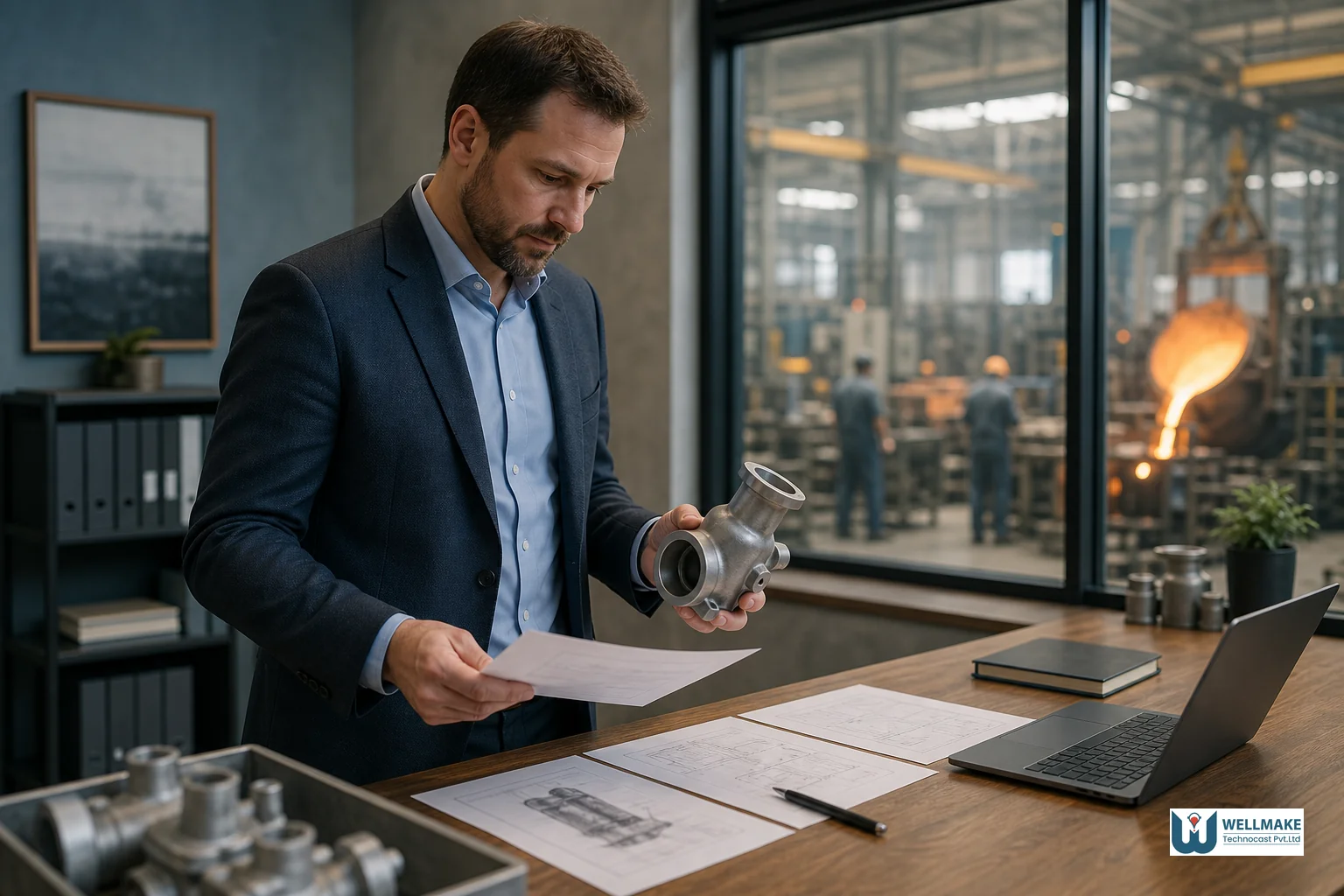
A sourcing engineer at a European pump manufacturer once approved a new casting supplier after a single video call and one well-finished sample part. Eight months later, the second production batch arrived with porosity defects that hadn't shown up in the sample run, and the assembly line sat idle for three weeks while the team scrambled for an emergency reorder. Nothing about that supplier's paperwork was wrong. The team just never checked it.
That story repeats across procurement departments every year, and it's almost always avoidable. Learning how to qualify an overseas investment casting supplier is not an optional extra step before you place a purchase order, it's the process that decides whether your supply chain holds up under real production volume. This guide walks through the exact criteria to check, the questions to ask, and the mistakes that trip up even experienced buyers when they source castings from a foundry on another continent.
What Does "Qualifying" a Casting Supplier Actually Mean?
Supplier qualification is different from simply picking a vendor because their quote looked good. It's a structured review of a foundry's management systems, technical capability, and track record, done before you commit real production volume to them. A single approved sample tells you the foundry can make one good part under close attention. Qualification tells you whether they can make the 500th part to the same standard, on time, six months from now.
This distinction matters even more when the supplier sits on another continent. You can't walk the shop floor on short notice, quality issues take longer to catch and resolve, and freight delays compound any production slip. A domestic supplier problem might cost you a week. An unqualified overseas supplier problem can cost you a quarter's worth of output.
Before you evaluate any single foundry, it helps to have a broader picture of what separates a dependable partner from a risky one. Our guide on how to choose the right investment casting foundry covers the bigger-picture decision criteria; this article focuses specifically on the qualification process itself, step by step.
1. Start With the Paperwork: Certifications That Actually Matter
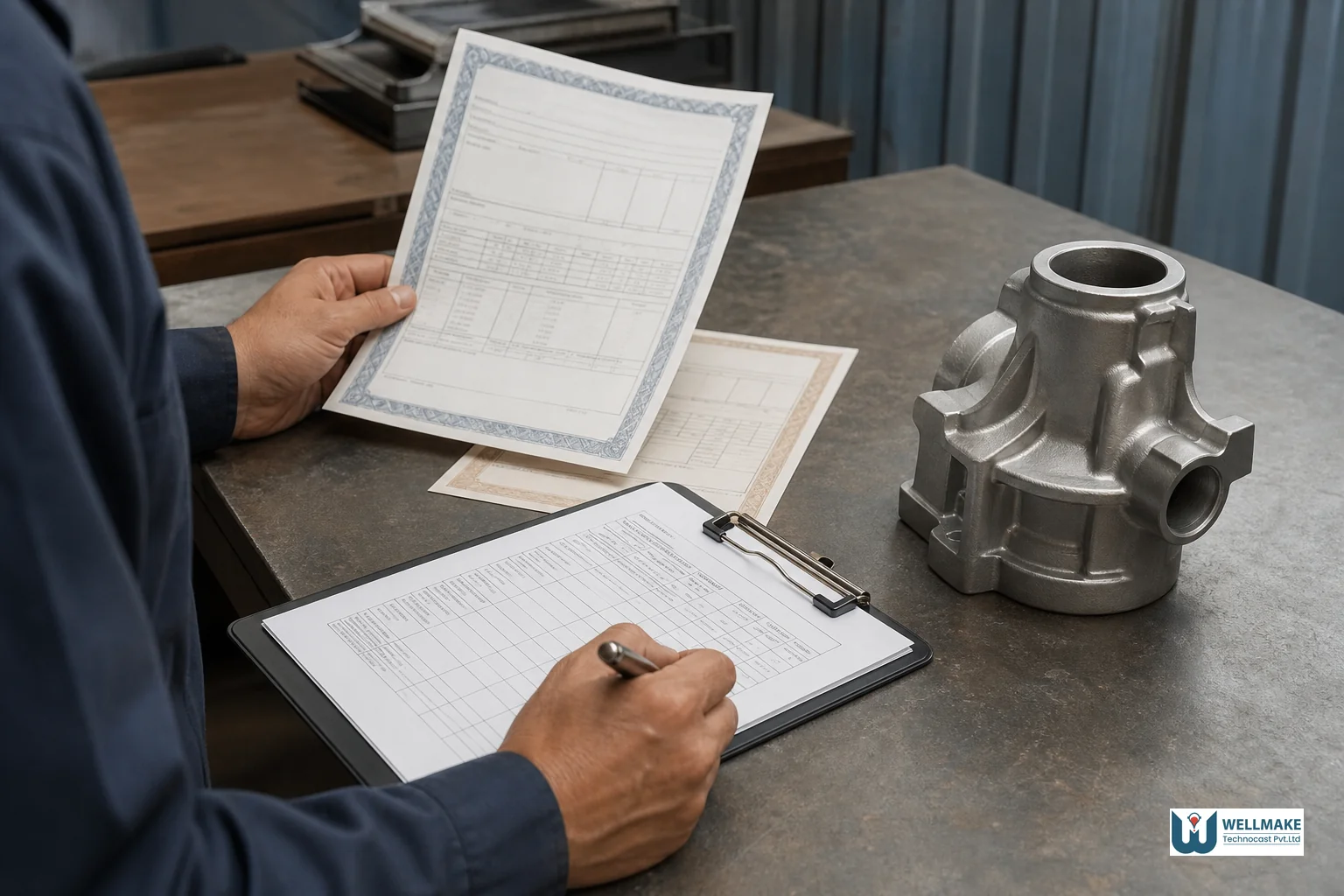
Certifications are the fastest filter for narrowing a long supplier list down to a short one. They aren't proof of quality on their own, but their absence is a clear warning sign, and their presence tells you the foundry has at least built the documented systems that quality manufacturing depends on.
- ISO 9001 (Quality Management Systems): The baseline certification for any serious manufacturing supplier. It confirms the foundry has documented, repeatable processes for production control, non-conformance handling, and continuous improvement.
- ISO 14001 (Environmental Management): Increasingly required by European and North American buyers who need to demonstrate responsible sourcing across their own supply chain. It also signals a foundry investing in long-term operational stability rather than cutting corners.
- ISO 45001 (Occupational Health and Safety): Worker safety systems correlate strongly with process discipline. A foundry that manages safety well tends to manage quality control well too, because both depend on the same culture of following procedure.
- Industry-specific certifications: Depending on your sector, you may also need evidence of compliance with standards like PED (Pressure Equipment Directive) for pump and valve components, NORSOK for oil and gas, or specific defence and railway qualification protocols relevant to your end market.
Don't just take a certificate number at face value. Ask for the current certificate with its expiry date, and check the issuing certification body's public registry when one is available. A foundry with nothing to hide will send documentation without hesitation. One that stalls, sends a scanned image with no visible certification body logo, or gives vague answers about "certification in progress" deserves closer scrutiny. Wellmake Technocast, for instance, holds all three certifications (ISO 9001, ISO 14001, and ISO 45001) as standard practice across its Rajkot, Gujarat operation, which buyers can verify directly during due diligence.
2. Assess Production Capacity Against Your Real Demand
A foundry can have excellent certifications and still be the wrong fit if its capacity doesn't match your program. This is where many buyers make a costly assumption: they check whether a supplier can make the part, but not whether the supplier can make enough of the part, consistently, alongside their existing customer base.
Ask for specifics, not generalities:
- Monthly tonnage capacity: A foundry running near 70 MT per month, for example, gives you a concrete benchmark to compare your annual volume against. If your program alone would consume 40% of their stated capacity, ask how that affects lead times for your reorders.
- Component size range: Foundries that handle parts from a few grams up to 180 kg in the same facility usually have more flexible tooling and furnace setups. If your components sit at the extreme ends of a foundry's stated range, ask for evidence of similar parts they've already produced.
- Ferrous and non-ferrous capability: If your product line spans carbon steel, stainless steel, and non-ferrous alloys, confirm the foundry runs all of them in-house rather than subcontracting some alloys to a third party you'll never see.
- In-house machining: If you need line-ready, finish-machined components rather than raw castings, verify the foundry has its own CNC and machining capability. A supplier who casts in-house but outsources machining introduces an extra link in your supply chain, and an extra point of failure.
Capacity questions also connect directly to your production schedule. If you're still working out how casting fits into your timeline, our article on how investment casting works step by step explains where tooling, shell building, and finishing sit in the overall process, which helps you set realistic capacity expectations with any supplier you're evaluating.
3. Dig Into Quality Testing Capabilities
This is the section where qualification separates from wishful thinking. A foundry can tell you they run a tight quality process. What you need is evidence of the specific testing equipment and methods they use to catch defects before parts ship, not after your customer finds them.
Equipment to Ask About Directly
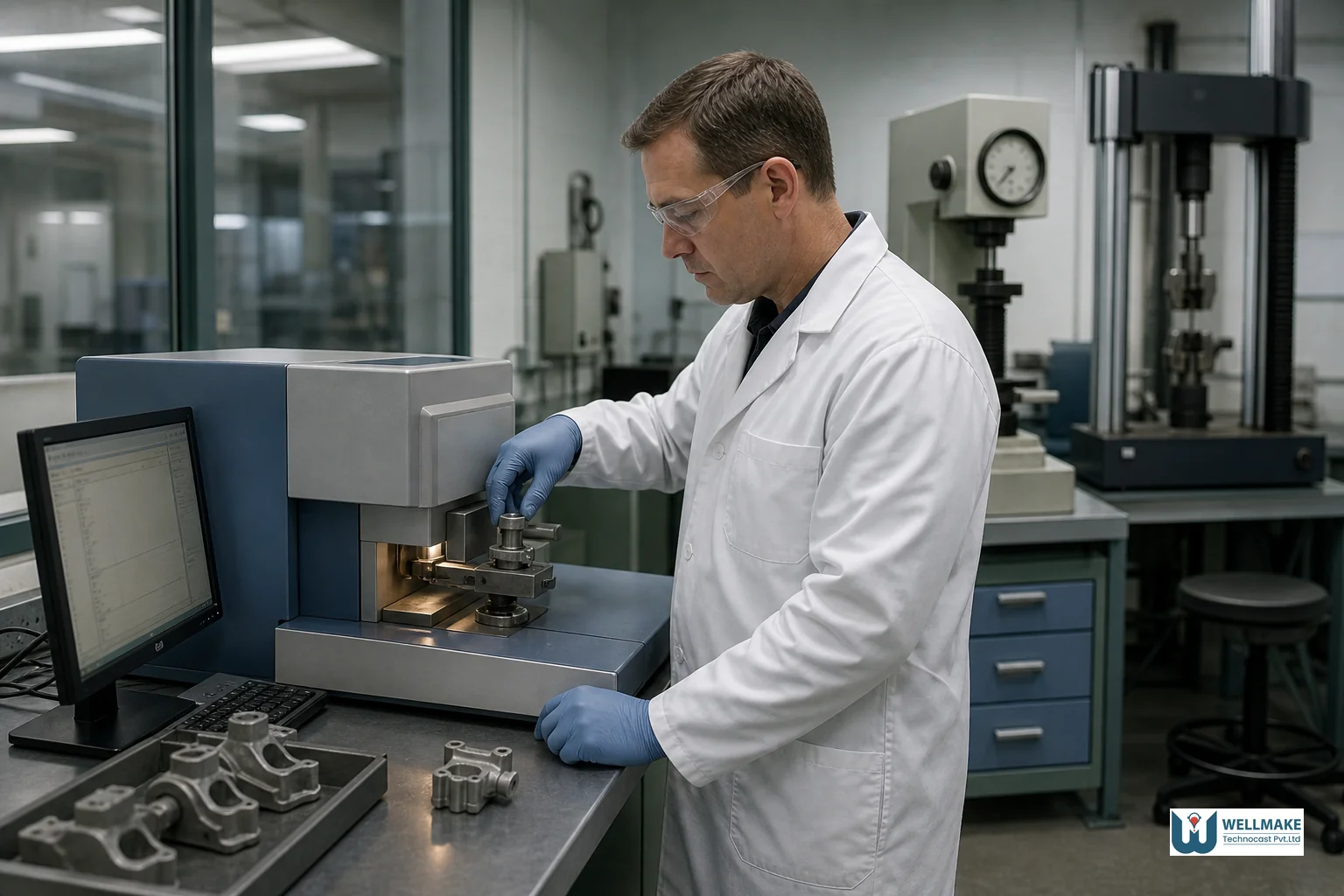
- Spectrometer analysis: Confirms the actual chemical composition of each melt matches the specified alloy grade. Without this, a foundry is essentially guessing at material composition based on raw input weights.
- Universal Testing Machine (UTM): Measures tensile strength, yield strength, and elongation, the mechanical properties that determine whether a part will survive its service load.
- Hardness testing: Verifies the casting meets specified hardness values (Brinell, Rockwell, or Vickers depending on your spec), which is especially critical for wear-resistant components in pump, valve, and mining applications.
- Impact testing: Confirms toughness at specified temperatures, a non-negotiable requirement for components used in cold climates or safety-critical defence and railway applications.
- Dimensional inspection: Ask whether the foundry uses coordinate measuring machines (CMM) or other precision instruments to verify tolerances, particularly for complex geometries with tight dimensional callouts.
The key distinction to probe here is in-house versus outsourced testing. A foundry that sends every sample to an external lab adds days or weeks to your qualification timeline and creates a dependency you can't control. In-house testing capability, backed by calibration records for each instrument, is one of the strongest indicators that a foundry treats quality as a continuous process rather than a final checkpoint.
If you're unsure how to interpret test reports or want a broader framework for judging casting quality before goods ship, our guide on evaluating casting quality from an overseas foundry walks through report interpretation in more depth. It also helps to understand achievable tolerances up front, covered in our breakdown of what tolerances investment casting can achieve, so you know what's realistic to specify.
4. Verify Material Traceability From Melt to Shipment
Traceability means every casting can be linked back to the specific heat or batch of raw material used to produce it, supported by mill test certificates and internal batch records. For automotive components, this matters for warranty claims. For defence, aerospace, and railway components, it's often a contractual and regulatory requirement, not a nice-to-have.
When qualifying a supplier, ask specifically:
- Can they provide a heat number for every batch of castings shipped?
- Do they retain mill test certificates from their raw material suppliers, and will they share copies?
- How long do they retain traceability records, and can they produce documentation for a batch shipped a year earlier?
- Is traceability data tied to their ISO 9001 quality management system, or handled informally outside the documented process?
A supplier who can't produce this documentation on request, or who treats the question as unusual, is telling you something important about how seriously they treat quality control across the rest of their operation. This is one of the clearest, fastest ways to separate a foundry built for export-grade manufacturing from one that's only ever sold into less demanding domestic markets.
5. Check the On-Time Delivery Track Record
Quality means little if the parts arrive too late to use. Investment casting is already a multi-week process by nature, tooling design, wax pattern building, shell construction, casting, finishing, and machining all happen in sequence before a part is ready to ship. Add international freight and customs clearance, and a realistic lead time for a new program often runs 10 to 16 weeks, sometimes longer for complex geometries or first-article tooling.
When qualifying a supplier, don't just ask "what's your lead time?" Ask for their actual on-time delivery percentage over the past 12 to 24 months, and ask how they define "on-time" (ex-works date versus arrival at your dock are very different commitments). Request contactable references from existing customers in a similar industry to yours, and ask those references directly about delivery consistency, not just part quality.
It's also worth understanding how production timelines actually break down before you commit to a schedule with any new supplier. Our detailed look at investment casting tooling costs explains why first-article tooling adds time up front, and it's worth building buffer time into your first purchase order rather than assuming a new supplier will hit best-case lead times on the very first run.
6. Ask These Critical Questions Before You Place an Order
Beyond documentation and equipment lists, the way a foundry answers direct questions tells you a lot about how they'll behave once you're a paying customer. Bring this list to your first serious supplier conversation:
- "Walk me through what happens when you find a non-conformance." Listen for a documented corrective action process, not just "we scrap it and remake it."
- "Who owns the tooling once it's built, and what happens if we switch suppliers later?" Get this in writing before production starts, not after a dispute arises.
- "How do you ensure the 500th part matches the first sample?" This tests whether they have process controls beyond the initial approval run.
- "What export documentation do you handle, and what do we need to arrange on our end?" Confirms whether they're experienced with international shipping, customs paperwork, and Incoterms relevant to your country.
- "Can our engineering team communicate directly with your production or quality team, not just a sales contact?" Direct technical communication reduces translation errors on complex specifications.
- "What's your environmental and safety compliance record, and can you share your ISO 14001 and ISO 45001 audit history?" A confident, specific answer here reflects genuine system maturity.
Vague, defensive, or overly rehearsed answers to any of these are worth flagging. A foundry confident in its own operation will welcome detailed questions rather than deflect them. For a deeper list of warning signs to watch for during this stage, see red flags to avoid when sourcing from a foundry.
Comparing Qualification Approaches: Sample-Only vs Full Audit vs Third-Party Inspection
Not every program justifies the same depth of qualification. A low-risk, low-volume trial order calls for a different approach than a multi-year defence or aerospace contract. The table below compares the three most common qualification approaches buyers use.
| Approach | Typical Cost | Time Required | Thoroughness | Best Suited For |
|---|---|---|---|---|
| Sample-only approval | Low (sample cost only) | 1-3 weeks | Low, confirms geometry and finish only, not process consistency | Low-risk components, non-critical applications, small trial orders |
| Documentation-based qualification | Low to moderate (staff time) | 2-4 weeks | Moderate, verifies certifications, test capability, and traceability on paper | Standard industrial components, repeat-order programs, most OEM sourcing |
| On-site or virtual factory audit | Moderate to high (travel or third-party fees) | 4-8 weeks | High, confirms equipment exists, is calibrated, and processes are followed in practice | Defence, aerospace, railway, pump and valve programs with strict compliance needs |
| Third-party inspection agency | Moderate (per-inspection fee) | Ongoing, per shipment or per milestone | High for specific batches, doesn't replace full qualification but adds ongoing assurance | High-volume programs, safety-critical parts, first few production runs with a new supplier |
Many procurement teams combine approaches: a documentation-based qualification up front, followed by a virtual or on-site audit before the first major production release, then periodic third-party inspection for critical shipments. If your components serve regulated sectors like defence or railways, the audit step generally isn't optional. Our guide on how to audit a casting supplier before ordering breaks this process down further.
Common Mistakes Buyers Make When Skipping Qualification
Even experienced procurement teams fall into predictable traps when qualification gets rushed. Watch for these patterns:
- Approving based on one flawless sample. A hand-finished sample part, built with extra attention because it's a new customer's first order, doesn't prove production consistency. Ask for parts from an actual production run, not a showcase piece.
- Ignoring how minimum order quantity affects total cost. Buyers sometimes qualify a supplier on price per piece without accounting for how MOQ requirements change the total landed cost of a program. This is worth working through before you commit, and our article on how MOQ affects investment casting costs is a useful reference here, alongside understanding what affects investment casting cost per kg more broadly.
- Overlooking machining capability. A foundry with excellent casting quality but no in-house machining forces you to manage a second supplier relationship, which adds cost, lead time, and coordination risk you didn't budget for.
- Underestimating communication and time-zone friction. Technical drawings with ambiguous tolerances or GD&T callouts get misread more easily across language and time-zone gaps. Confirm the foundry has engineers who can review drawings directly, not just a sales team relaying messages.
- Skipping the audit because "the sample looked fine." This is the single most common and most costly mistake. A documented process, verified equipment, and a real production-run inspection catch problems a sample simply can't reveal.
Buyers comparing overseas sourcing against a domestic option often ask whether the qualification effort is even worth it. In many cases, it is, once landed cost, capacity, and lead time are factored in. Our regional comparisons, including India vs local foundry: best castings for Australia, walk through how that trade-off plays out for specific markets.
Building a Qualification Checklist for Your Team
Turn everything above into a working checklist your procurement and engineering teams can apply consistently across every new overseas foundry you evaluate:
- ☐ Current ISO 9001, 14001, and 45001 certificates verified with expiry dates
- ☐ Industry-specific certifications confirmed (PED, NORSOK, defence qualification, as applicable)
- ☐ Monthly tonnage capacity and component size range documented
- ☐ Ferrous and non-ferrous casting capability confirmed for your alloy requirements
- ☐ In-house machining capability verified if line-ready parts are required
- ☐ Spectrometer, UTM, hardness, and impact testing equipment confirmed with calibration records
- ☐ Dimensional inspection method (CMM or equivalent) confirmed for your tolerance requirements
- ☐ Material traceability process reviewed, including heat numbers and mill test certificates
- ☐ On-time delivery percentage requested with contactable references
- ☐ Non-conformance and corrective action process explained in detail
- ☐ Tooling ownership terms confirmed in writing
- ☐ Export documentation and Incoterms experience confirmed
- ☐ Direct technical communication channel established with engineering or quality staff
Weight these criteria according to your industry. A defence or aerospace program should treat traceability and audit depth as non-negotiable. An automotive or general engineering buyer sourcing non-critical brackets might reasonably move faster through documentation-based qualification. Either way, the checklist gives your team a consistent standard instead of a judgment call made under deadline pressure.
Frequently Asked Questions
How long does supplier qualification typically take?
A documentation-based qualification usually takes two to four weeks. Adding an on-site or virtual audit extends that to six to eight weeks in most cases. Build this timeline into your program schedule rather than compressing it to meet a launch date, since a rushed qualification is the most common cause of later quality escapes.
Should I always request a factory audit before placing an order?
Not necessarily for every program. Low-risk, low-volume components may only need documentation-based qualification. But for safety-critical, regulated, or high-volume programs, an audit (on-site or conducted via detailed video walkthrough) is strongly recommended before committing to production quantities.
What's the difference between qualifying a supplier and approving a single part?
Part approval, often called first article inspection, confirms one specific component meets its drawing and specification. Supplier qualification is broader: it evaluates whether the foundry's overall systems, equipment, and track record can reliably produce compliant parts across an entire program, not just the one sample submitted for approval.
Is India a reliable source for investment castings in defence, pump and valve, or aerospace-adjacent sectors?
India has become a significant global investment casting exporter, and foundries with triple ISO certification (9001, 14001, 45001), in-house testing labs, and export experience serve customers across Europe, North America, and the Middle East in exactly these sectors. As with any overseas sourcing decision, the qualification process described above is what separates a dependable long-term partner from a costly gamble, regardless of country of origin.
The goal of qualification isn't to find a perfect supplier. It's to find one whose documented systems, tested capabilities, and track record give you confidence before a single production dollar is committed.
Wellmake Technocast has built its export business around exactly the criteria covered in this guide: triple ISO certification, in-house spectrometer, UTM, hardness, and impact testing, a 70 MT monthly capacity spanning components from a few grams to 180 kg, and both ferrous and non-ferrous casting alongside in-house machining for line-ready parts. If you're working through the qualification process for an upcoming program, our team can walk you through our certifications, quality control data, and production references directly. Explore our product range to see the component categories and industries we serve, or get in touch to request our latest quality documentation and start your own supplier qualification process with confidence. When you're ready to move a program forward, contact us today and we'll help you evaluate whether Wellmake Technocast is the right long-term casting partner for your supply chain.