
Investment Casting for Mining Equipment in Spain
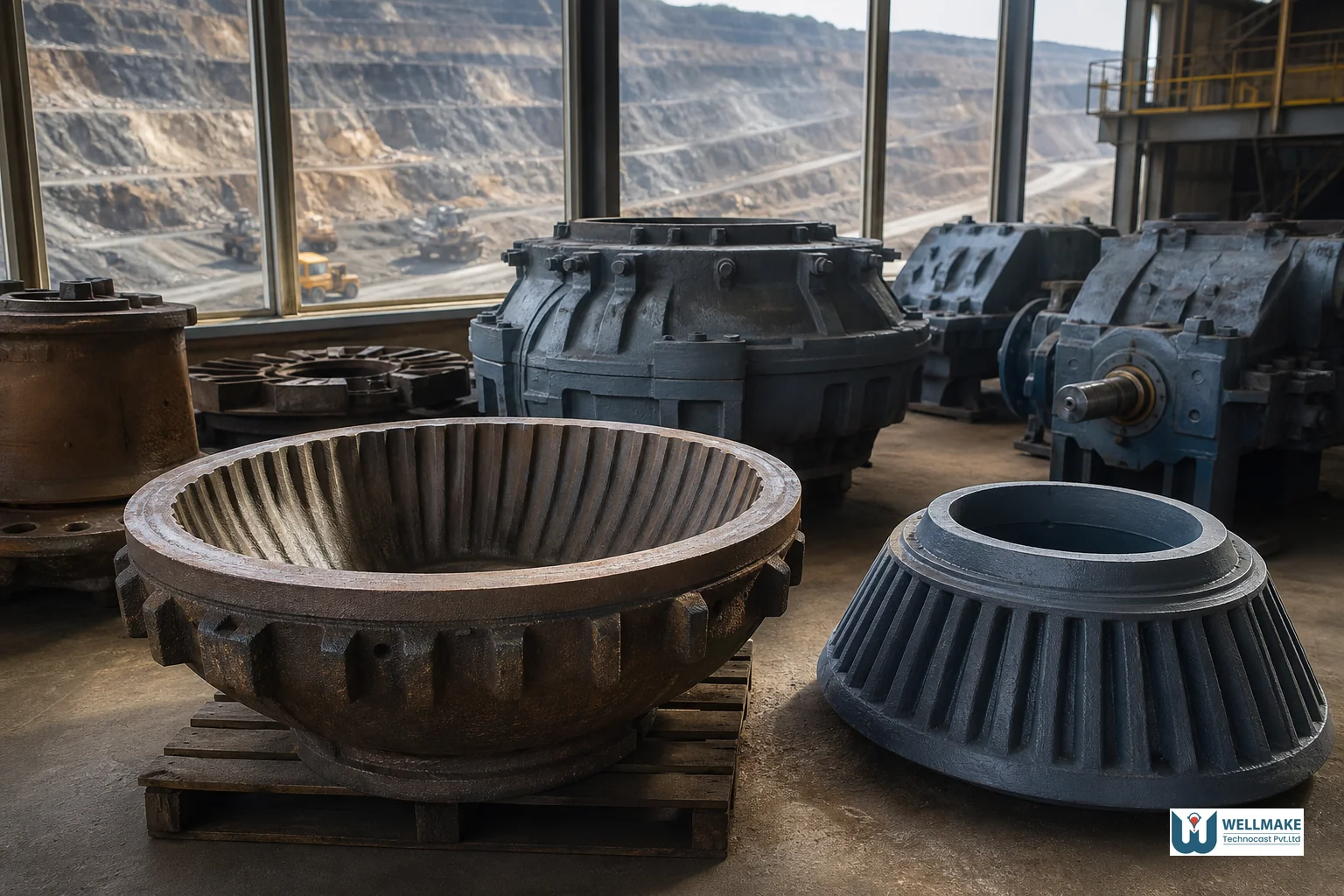
A maintenance manager at a copper processing site in Huelva recently spent four months chasing a single batch of crusher liners. Her regional supplier, one of the last foundries in southern Spain still pouring manganese steel, quoted a delivery window that would have idled a secondary crushing line for weeks. The backup quote from a foundry near Bilbao came in faster, but at a price that made the finance team ask hard questions. That gap between "available" and "affordable" is pushing more Spanish mining and earth-moving equipment builders to look outside the peninsula entirely, and increasingly toward investment casting for mining equipment Spain buyers can qualify remotely and scale with confidence.
Spain's mining sector, from the copper belt around Riotinto to the coal and slate operations in Asturias and the aggregate quarries scattered across Andalusia, runs on components that take a beating: crusher liners, bucket teeth, chute plates, pump impellers, and structural brackets that hold up under constant abrasion and impact. Sourcing these parts reliably, at tight tolerances and without a six-figure tooling surprise, is getting harder to do with a shrinking pool of domestic foundries. This guide walks through what can actually be investment cast for mining applications, how the process runs from tooling to a line-ready part, and how to properly vet an overseas foundry, specifically an ISO-certified Indian supplier, before you commit a production order.
Why Spanish Mining Equipment Manufacturers Are Rethinking Their Casting Supply Chain
Spain still has real casting capacity, but energy prices and consolidation have thinned out the number of foundries willing to take on mid-volume, complex mining components. Many general-purpose foundries in Spain and neighboring France or Germany focus on automotive or construction castings, leaving mining OEMs competing for limited furnace time against higher-margin work. The result is longer queues, price volatility, and a shrinking set of suppliers who can hold tight tolerances on abrasion-resistant alloys.
That's the gap an ISO-certified foundry abroad can fill, provided the buyer knows how to evaluate one properly. Wellmake Technocast, based in Rajkot, Gujarat, has built its export business around exactly this kind of gap: manufacturers in Europe, North America, and the Middle East who need a single source for both raw castings and fully machined, line-ready components. With ISO 9001, ISO 14001, and ISO 45001 certification and 70 metric tons of monthly capacity, the foundry positions itself as a partner for heavy-duty sectors, mining included, where failure isn't an option and lead times matter as much as price.
1. Identify Which Mining Components Suit Investment Casting
Not every mining part needs investment casting. Large, simple structural pieces are often better served by sand casting or fabrication. Investment casting earns its place when a component combines complex geometry, tight tolerance requirements, and a demanding alloy in the same part. That description fits a surprising number of mining and earth-moving components:
- Wear parts: crusher jaw plates, cone liners, bucket teeth, chute liners, and impact hammers cast in high-chrome white iron or austenitic manganese steel for abrasion resistance.
- Housings: gearbox housings, bearing housings, and pump casings that need internal cavities or curved passages difficult to machine from solid billet.
- Brackets and mounting components: conveyor idler brackets, chassis mounts, and structural connectors that carry load but also need weight reduction through internal ribbing.
- Impellers and slurry-handling parts: multi-vane impellers and volute casings for slurry pumps, typically cast in duplex stainless steel or high-chrome iron where erosion resistance matters as much as strength.
- Fasteners and small hardware: latch components, hinges, and connector fittings used across conveyor and screening equipment.
The common thread is geometry that would be expensive or impossible to machine from a solid block, combined with an alloy that needs a controlled solidification process to avoid porosity or segregation. If your engineering team has been asking what tolerances investment casting can actually achieve for a particular wear part, that's usually the first sign the part is a strong candidate.
It's also worth checking whether the part is genuinely too complex for cheaper routes. For simpler shapes with looser tolerance needs, a comparison against sand casting economics or machining from billet can save you from paying for precision you don't need.
2. Understand the End-to-End Process From Tooling to Line-Ready Delivery
Mining equipment buyers often assume "casting" means a rough part that still needs extensive downstream work before it fits on an assembly line. That's true with sand casting. Investment casting, done properly, can deliver something much closer to finished.
The process starts with a wax injection tool built from your part drawing. Wax replicas are assembled onto a central sprue to form a tree, then dipped repeatedly in ceramic slurry and stuccoed with refractory sand to build a shell several layers thick. Once the shell cures, the wax is melted out in an autoclave, leaving a hollow ceramic mold. Molten metal, whether high-chrome iron, manganese steel, or duplex stainless, is poured into the preheated shell, and after cooling, the shell is broken away and the individual castings are cut from the tree.
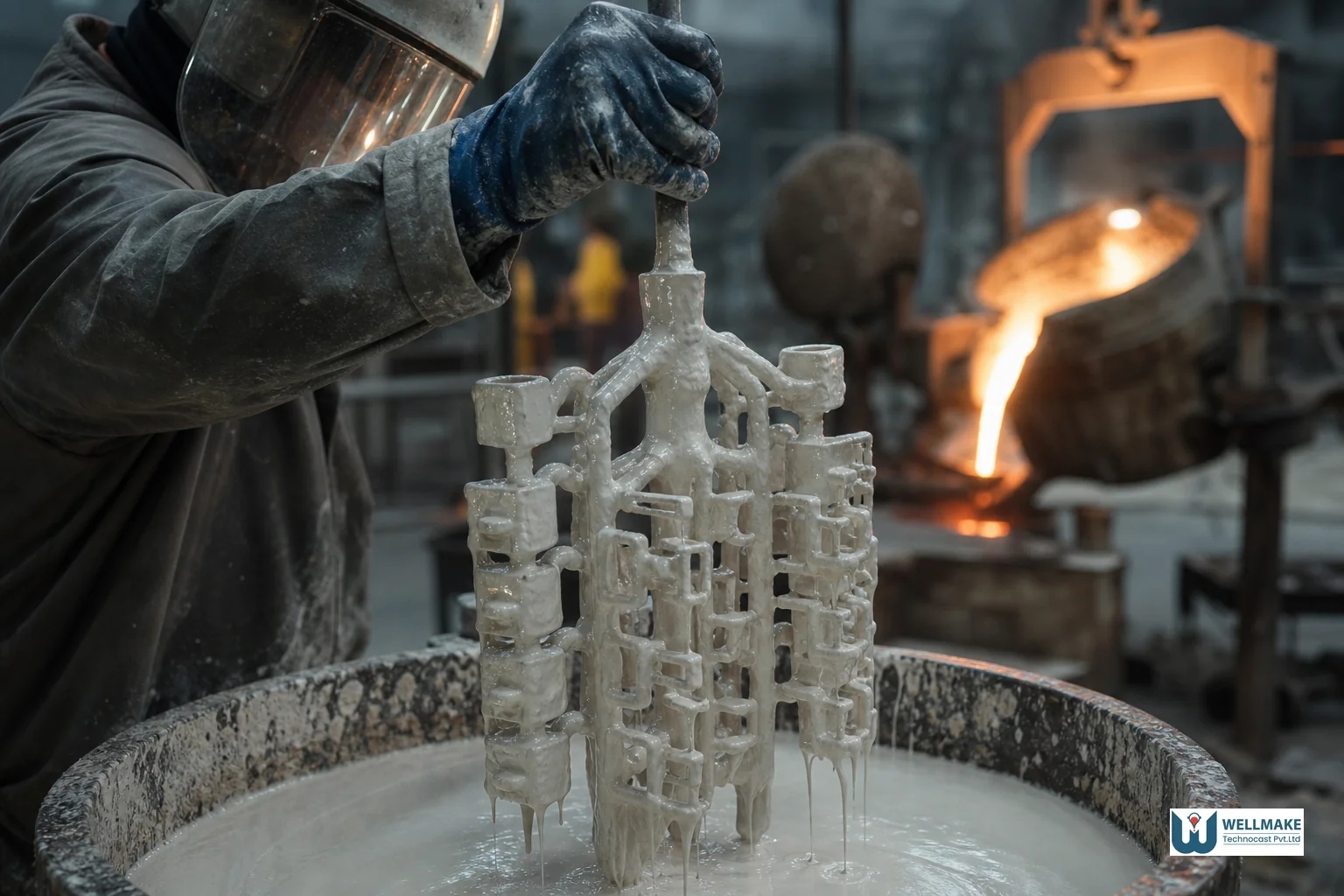
From there, castings go through grinding, heat treatment specific to the alloy (critical for manganese steel, which needs solution annealing to develop its work-hardening properties), and then into machining if the part calls for it. This is where a single-source supplier earns its value: instead of shipping rough castings to a separate machine shop, an integrated foundry can turn wax to finished, dimensionally verified part under one quality system. If you want the full breakdown of each stage, this step-by-step process guide covers the shell-building and pouring stages in more detail.
Tooling is the one upfront cost buyers underestimate. A hardened steel wax-injection die for a mid-sized crusher liner or bracket can represent a meaningful share of first-order cost, though it amortizes across repeat production runs. Understanding how that number is built, cavity count, tool steel grade, and part complexity, helps you negotiate and budget correctly; the tooling cost breakdown is worth reviewing before your first RFQ.
3. Set Realistic Quality and Tolerance Expectations
Mining components live in a rough environment, but that doesn't mean tolerance discipline is optional. A crusher liner with an uneven wall thickness wears unevenly and fails early. A pump impeller with a shifted bore throws off balance and vibration. The right approach is to match tolerance expectations to the function of each part rather than specifying tight tolerances everywhere by default.
For wear parts like liners and teeth, general dimensional tolerances in the ±0.3 to ±0.5 mm range on cast surfaces are typical, with critical mounting features held tighter through secondary machining. For housings and impellers where bearing fits or sealing surfaces matter, machined features routinely hold ±0.05 to ±0.1 mm. A foundry that understands mining applications will tell you upfront which features can stay as-cast and which need machining, rather than promising tight tolerances across the whole part just to win the order.
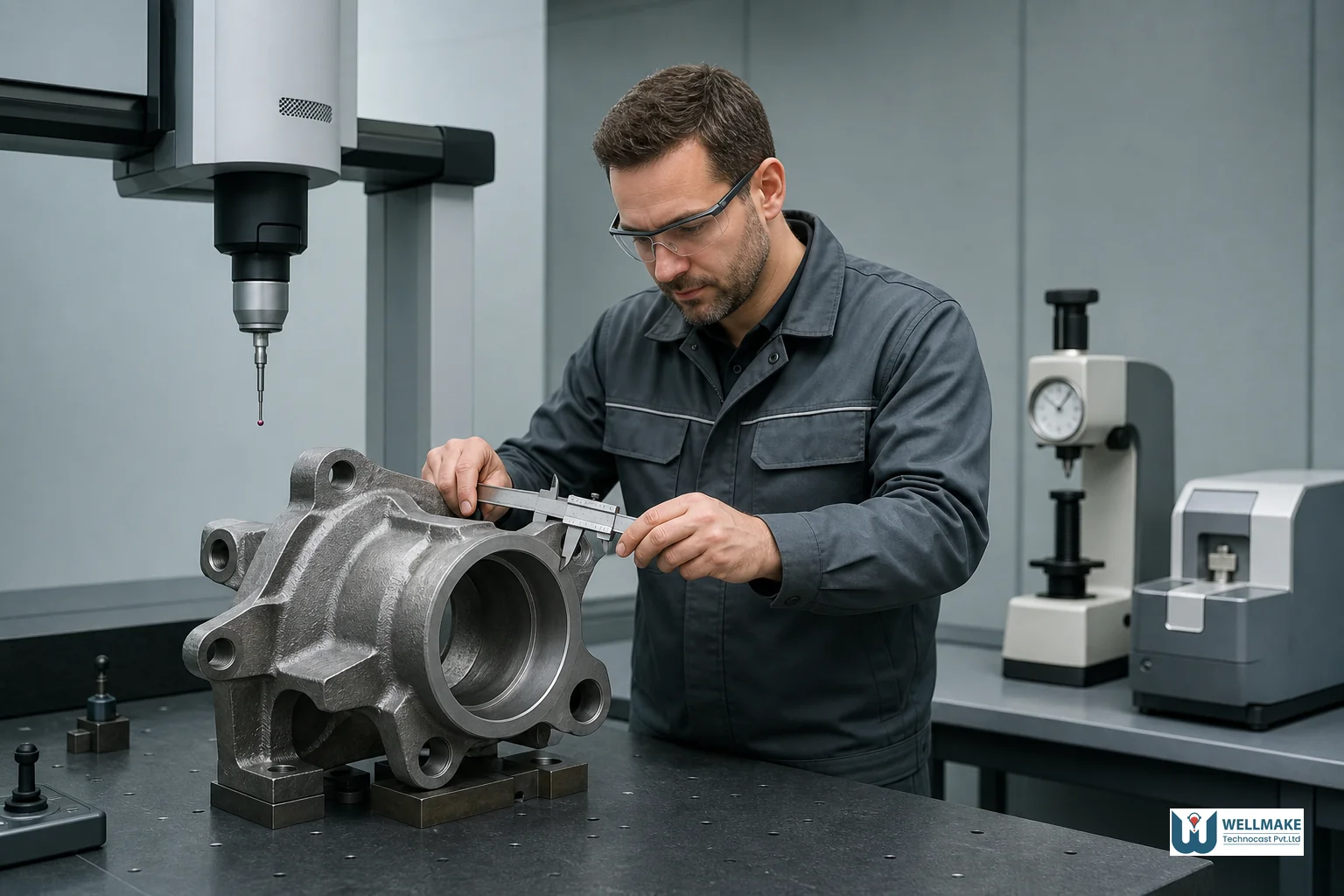
Quality verification should include chemical composition checks via spectrometer, mechanical testing on a universal testing machine (UTM), hardness testing (particularly important for manganese steel and high-chrome iron, where hardness correlates directly with wear life), and impact testing for parts subject to shock loading, like hammer mill components. These are standard capabilities at a properly equipped foundry, and you should ask to see test reports tied to your specific heat lot, not generic material certificates. Relevant standards for mining castings typically reference ASTM material specifications alongside EN and ISO dimensional standards, and a competent export foundry should be fluent in mapping your European drawing callouts to the equivalent international grade.
4. Compare Sourcing Routes: Local Spanish/EU Foundry vs Indian Investment Casting Partner
Every sourcing decision comes down to trade-offs between lead time, cost, minimum order quantity, and how much finishing work you still need to do after the casting arrives. The table below lays out how a typical local or regional EU foundry compares with an ISO-certified Indian investment casting partner for mining-grade components.
| Factor | Local Spanish / EU Foundry | ISO-Certified Indian Foundry (e.g., Wellmake Technocast) |
|---|---|---|
| Typical lead time (production run) | 10-20 weeks, longer during energy-cost driven capacity cuts | 8-14 weeks including sea freight to Spanish ports |
| Cost per kg (finished, machined) | Higher, driven by energy and labor costs | Typically 25-40% lower on comparable alloy and finish |
| Minimum order quantity | Often high due to furnace scheduling economics | More flexible, especially for repeat-order relationships |
| Single-source cast + machined delivery | Frequently outsourced to a separate machine shop | In-house machining reduces handoffs and QC gaps |
| Tooling cost | Higher tool steel and labor rates | Lower upfront tooling investment |
| Logistics complexity | Low, short domestic or intra-EU transit | Moderate, requires sea freight planning and customs handling |
| Certification standard | Varies by foundry | ISO 9001, ISO 14001, ISO 45001 across the facility |
Local sourcing still wins when you need extremely short-notice spares, very low volumes, or parts where transit time genuinely can't be absorbed into your maintenance schedule. But for planned production runs, tooling for new equipment lines, or wear-part programs where you can forecast demand a quarter or two ahead, the cost and flexibility gap increasingly favors an established export foundry. This mirrors what buyers in other European markets have found; the same dynamic shows up in comparisons between Indian and local foundries for Australian buyers and in how German OEMs are evaluating overseas casting supply.
5. Evaluate an ISO-Certified Indian Foundry as a Reliable Supply Partner
Price and lead time get a foundry shortlisted. Quality systems, traceability, and export experience are what determine whether that relationship survives past the first order. Before committing to a production run, work through a structured evaluation rather than relying on a sample part and a good sales call.
What to Check Before Placing an Order
- Certifications with substance: confirm ISO 9001 (quality management), ISO 14001 (environmental management), and ISO 45001 (occupational health and safety) are current and ask for the certificate numbers so you can verify them independently.
- In-house testing capability: a foundry with its own spectrometer, hardness tester, UTM, and impact testing equipment can catch problems before shipment rather than after your line stops.
- Sample-first validation: request first-article samples with full dimensional and material reports before authorizing a production batch, especially for a new alloy or geometry.
- Capacity match: confirm the foundry's monthly tonnage and component size range actually cover your part. A 70 MT monthly capacity facility handling components from a few grams up to 180 kg, for instance, tells you whether your largest housing or liner is within their normal operating range or an edge case.
- Export track record: ask for references to comparable sectors, defence, railways, or pump and valve manufacturing, where quality demands mirror mining's toughness requirements.
- Machining integration: confirm whether machining happens in-house or is subcontracted, since subcontracted machining introduces another quality handoff and another point of failure.
If you want a more granular checklist, this guide to qualifying an overseas investment casting supplier and this supplier audit framework both go deeper into documentation requests and site-visit questions. It's also worth reviewing common warning signs before you sign anything; the red flags checklist covers issues like vague material certificates and unwillingness to share test data, which apply just as much to mining components as to pump and valve parts.
Communication and Logistics Across the Spain-India Trade Lane
Time zone overlap between Spain and India is workable, roughly four to five hours depending on daylight saving, which leaves a reasonable window for live calls on engineering questions. Freight typically moves via container shipping to major Spanish ports including Valencia, Barcelona, or Algeciras, with transit times in the range of three to five weeks depending on routing and season. Building that transit time into your production planning, rather than treating it as a surprise, is the difference between a smooth supply relationship and a scramble every time a batch is late.
6. Plan Your First Order: Practical Steps for Spanish Buyers
Once you've shortlisted a foundry, the process of moving from inquiry to a reliable repeat order follows a fairly predictable path. Treat the first order as a qualification exercise, not just a purchase.
- Prepare a complete RFQ package: full drawings with tolerance callouts, material specification (grade and any hardness or impact requirements), annual or per-batch volume estimates, and any surface finish or coating requirements.
- Request a sample batch first: even for an established part, a first production run from a new supplier should include first-article inspection reports covering dimensions, chemistry, and mechanical properties.
- Clarify machining scope in the quote: specify exactly which features need to be machined versus left as-cast, so the quote reflects true line-ready cost rather than a rough-casting price that hides downstream work.
- Confirm packaging and logistics terms: mining components are heavy and often shipped in bulk; agree on Incoterms, packaging method, and expected transit time before the first shipment leaves the factory.
- Build in a second-source safety net: even after qualifying a strong overseas partner, keep a local relationship for true emergency spares while shifting planned volume to the more cost-effective supplier.
For manufacturers weighing whether to route pump-adjacent slurry components through the same supplier, it's worth reviewing how pump and valve manufacturers in Sweden have approached similar sourcing decisions, since impeller and casing geometries often overlap closely with mining slurry pump requirements.
Frequently Asked Questions
Is investment casting suitable for large, heavy-duty mining wear parts?
Yes, within limits. Investment casting handles components from a few grams up to roughly 150-180 kg efficiently at most established foundries. Very large single-piece liners beyond that range may need to be cast in sections or produced through sand casting instead. For mid-sized wear parts, brackets, and housings, investment casting delivers tighter tolerances and better surface finish than sand casting at a comparable or lower total cost once machining is factored in.
How does investment casting compare to sand casting for mining components?
Investment casting produces a smoother as-cast surface and holds tighter dimensional tolerances, which reduces machining time and material waste. Sand casting is generally cheaper for very large, simple shapes with loose tolerances. For complex geometries like impellers, curved housings, or parts with internal features, investment casting usually wins on total delivered cost once you account for reduced machining.
What is the minimum order quantity for investment cast mining components?
Minimum order quantities vary by part size, tooling amortization, and alloy. Many export foundries offer more flexible MOQs than domestic European foundries because higher-volume export operations spread tooling and furnace costs across a broader customer base. It's worth discussing your specific volume needs directly, since MOQ terms can often be structured around a phased ordering schedule rather than a single large commitment.
How long does production typically take from order to delivery?
For a part with existing tooling, production runs typically take several weeks for casting, heat treatment, and machining, plus transit time to Spain. For a new part requiring tooling development, add several additional weeks for tool fabrication and first-article sample approval. Planning your order calendar around these realistic windows, rather than assuming rush delivery is always available, avoids production line surprises.
What quality documentation should I expect with each shipment?
At minimum, expect a material test certificate showing chemical composition, a dimensional inspection report for critical features, and hardness test results where applicable. For mining components subject to shock loading, impact test data should also be available on request, tied to the specific production lot rather than a generic historical average.
A reliable casting partner isn't the one with the lowest quote. It's the one whose quality documentation, sample parts, and communication hold up consistently across your third, fifth, and twentieth order, not just the first.
Sourcing wear-resistant, complex mining components doesn't have to mean choosing between a slow, expensive domestic foundry and an unverified overseas gamble. An ISO-certified partner with in-house testing, integrated machining, and export experience across heavy-duty sectors can deliver line-ready components at a cost structure that a shrinking Spanish or wider EU foundry base often can't match. Wellmake Technocast has spent nearly two decades building exactly that kind of supply relationship for mining, pump and valve, and general engineering manufacturers worldwide. Explore the product range to see the alloys and component types already in production, or get in touch to discuss your drawings and start with a sample batch. If you're ready to move a specific crusher liner, housing, or impeller program off a strained local supply chain, contact us today to begin the qualification process.