
Investment Casting Supplier in Germany: OEM Guide 2026
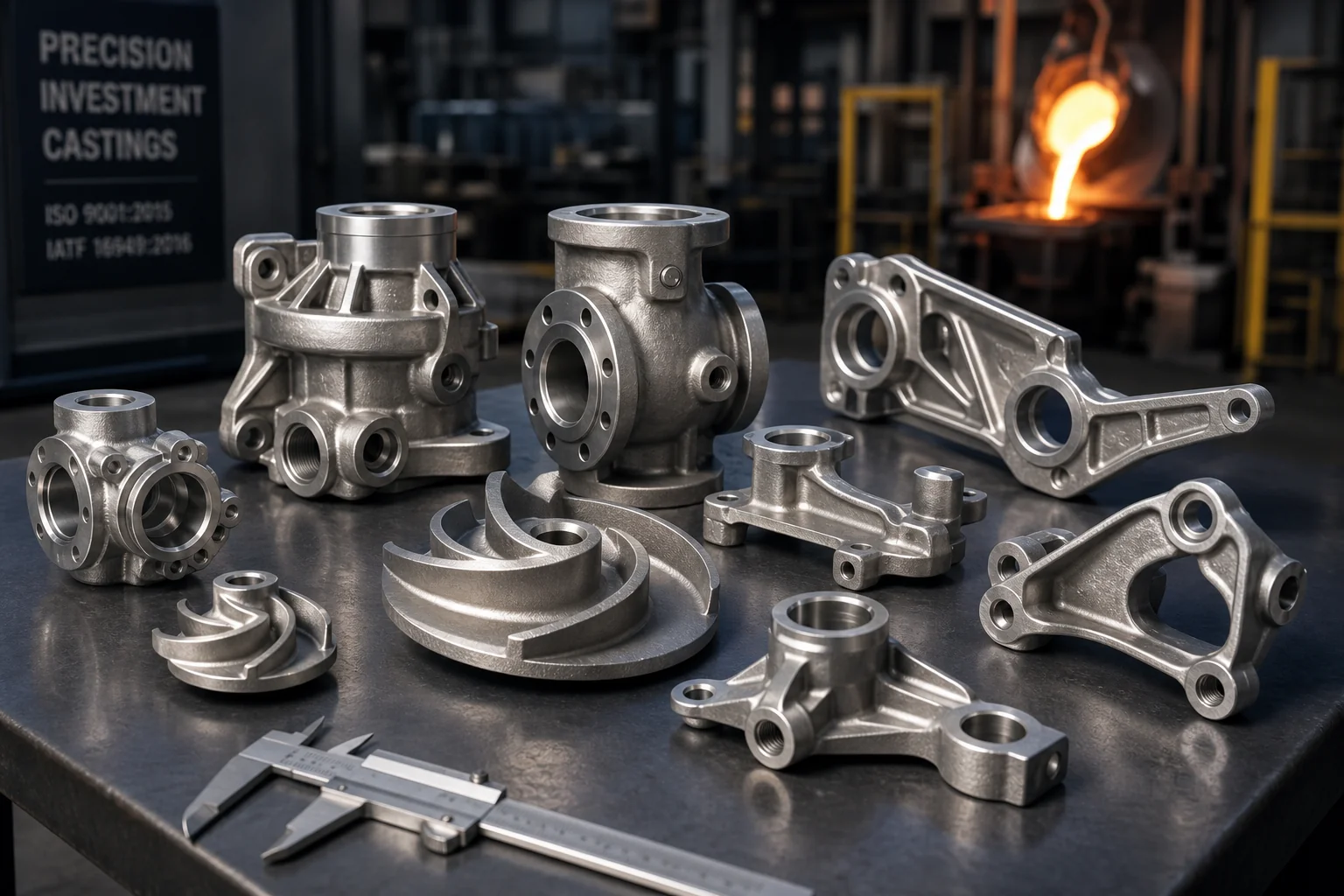
A procurement manager at a mid-sized German pump manufacturer recently shared a familiar frustration: three different European casting suppliers, three different quality outcomes, and a production line that couldn't afford the inconsistency. The solution came from an unexpected direction — a triple ISO-certified investment casting foundry in Rajkot, India, delivering line-ready stainless steel impellers to drawing spec, on schedule, at a fraction of the European cost.
That scenario is no longer unusual. German OEMs across automotive, oil & gas, pump & valve, and defence sectors are actively qualifying Indian investment casting suppliers as strategic long-term partners. This guide explains exactly what to look for, what to expect from the process, and how to onboard a reliable Indian foundry — so your supply chain gains precision, not risk.
Why German OEMs Are Turning to Indian Investment Casting Foundries
European manufacturing costs have risen sharply over the past decade. Energy prices, labour costs, and regulatory compliance overhead have made domestic casting increasingly expensive for components that don't require proximity to the assembly line. For German OEMs managing tight margins on complex metal parts, global sourcing is no longer a cost-cutting experiment, it's a structural supply chain decision.
India's investment casting sector has matured significantly. The city of Rajkot in Gujarat has emerged as one of the world's most concentrated foundry hubs, home to hundreds of precision casting manufacturers serving export markets across Europe, North America, and the Middle East. What was once a cost-arbitrage play has become a quality-first proposition: Indian foundries now hold ISO 9001, ISO 14001, and ISO 45001 certifications, operate modern ceramic shell technology, and supply components that meet or exceed DIN/EN dimensional and material standards.
The key advantages German procurement teams consistently cite include:
- Cost competitiveness: 30-50% lower total landed cost compared to equivalent European casting suppliers, without sacrificing dimensional accuracy
- Single-source capability: Leading Indian foundries supply both un-machined castings and fully machined, line-ready components, eliminating the need for a separate machining vendor
- Scalable capacity: Established foundries with 70 MT or more monthly output can absorb volume ramp-ups without lead time penalties
- Certification alignment: Triple ISO certification (9001/14001/45001) satisfies both quality and ESG compliance requirements increasingly demanded by German Tier-1 and OEM procurement policies
For German OEMs evaluating an investment casting supplier for OEM components, India, and Rajkot specifically, represents a proven, scalable sourcing destination rather than an emerging market gamble.
What Investment Casting Actually Delivers for OEM Components
Investment casting (also called lost-wax casting) produces metal components by creating a wax pattern of the desired part, coating it in ceramic, melting out the wax, and pouring molten metal into the resulting shell. The process sounds straightforward, but its engineering advantages over sand casting and die casting are substantial.
Near-Net-Shape Accuracy
Investment casting produces parts that are very close to their final geometry straight from the mould. Wall thicknesses as thin as 1.5 mm, internal passages, undercuts, and complex external profiles are achievable without secondary machining. This near-net-shape capability directly reduces material waste and machining time, two of the biggest cost drivers in conventional casting methods.
Un-Machined vs. Machined Components
German OEMs typically require one of two supply formats:
- Un-machined castings: Parts delivered in as-cast condition, ready for the customer's own machining or light finishing operations. Suitable for OEMs with in-house machining capacity who want to control final tolerances.
- Machined / line-ready components: Fully finished parts delivered to drawing specification, including all critical dimensions, surface finishes, and thread forms. These go directly to the assembly line, eliminating incoming machining costs entirely.
A capable foundry like Wellmake Technocast offers both formats, functioning as a true single-source supplier for the complete component, from raw casting to finished part.
Dimensional Range and Complexity
Investment casting accommodates components from a few grams (small connectors, fittings) up to 180 kg (large valve bodies, structural housings). Surface finish typically achieves Ra 3.2, 6.3 µm as-cast, with tighter finishes available post-machining. Tolerances of ±0.1 mm on critical dimensions are routinely achievable, making the process well-suited to the precision requirements of German automotive, aerospace, and pump & valve OEMs.
The 8-Step Investment Casting Process Explained
Understanding the manufacturing process helps procurement and engineering teams set realistic expectations for lead times, tooling requirements, and quality control checkpoints. Here is how a precision investment casting moves from design to dispatch.
Step 1: Wax Pattern Injection
A metal die (tooling) is machined to the exact geometry of the component. Molten wax is injected into the die under controlled pressure and temperature, producing a wax replica of the final part. Pattern accuracy at this stage directly determines the dimensional accuracy of the finished casting.
Step 2: Pattern Assembly (Tree Building)
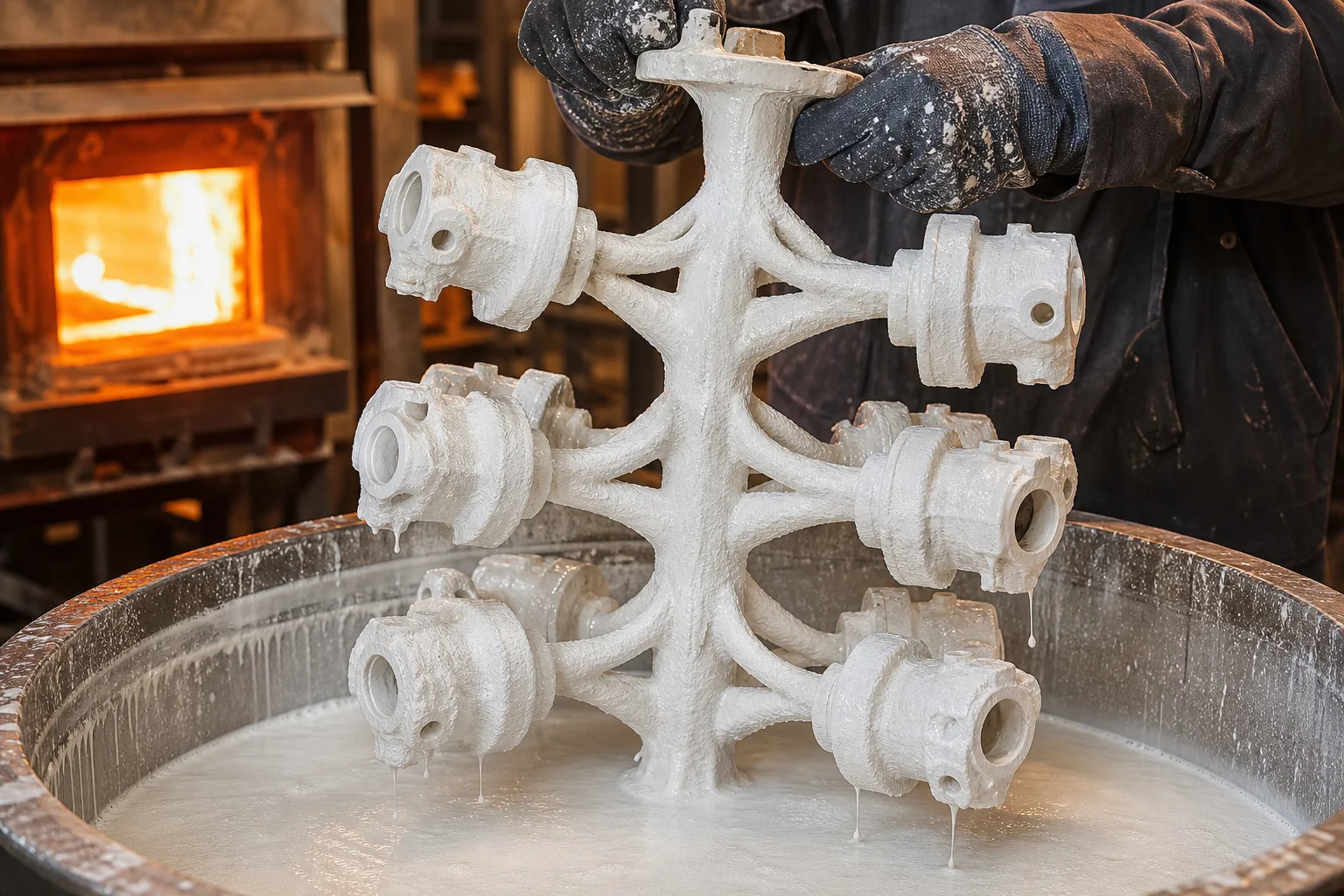
Individual wax patterns are attached to a central wax sprue to form a "tree." Multiple patterns on a single tree allow several components to be cast simultaneously, improving yield and reducing per-unit cost. The tree also includes gating and riser geometry to control metal flow during pouring.
Step 3: Ceramic Shell Building
The wax tree is repeatedly dipped in a ceramic slurry and coated with refractory stucco. Each layer is allowed to dry before the next is applied. Typically 8, 12 layers are built up, creating a ceramic shell 6, 10 mm thick. Shell quality at this stage determines surface finish and dimensional stability of the final casting.
Step 4: Dewaxing
The ceramic shell is placed in an autoclave where high-pressure steam melts and drains the wax rapidly. Fast dewaxing prevents the expanding wax from cracking the shell. The recovered wax is recycled back into the process, an important sustainability practice.
Step 5: Shell Firing
The empty ceramic shell is fired in a furnace at high temperature (typically 900, 1100°C). This burns out any residual wax, strengthens the ceramic, and pre-heats the mould to reduce thermal shock during metal pouring.
Step 6: Metal Melting and Pouring
The specified alloy is melted in an induction furnace and poured into the pre-heated ceramic shell. Precise temperature control and pouring speed are critical to achieving the correct microstructure, avoiding porosity, and filling thin-walled sections completely.
Step 7: Shell Removal, Cut-Off, and Grinding
After solidification and cooling, the ceramic shell is broken away by vibration or water blasting. Individual castings are cut from the tree using abrasive wheels or band saws. Gate stubs are ground flush, and any surface irregularities are dressed.
Step 8: Finishing, Inspection, and Dispatch
Components undergo heat treatment (where specified), shot blasting for surface preparation, and any required machining operations. Final inspection covers dimensional verification, surface finish measurement, and material certification. Approved parts are packed and dispatched with full quality documentation.
Material Options: Ferrous and Non-Ferrous Alloys for German OEM Specs
Material selection is one of the most critical decisions in the sourcing process. A capable investment casting foundry must demonstrate proficiency across a broad alloy range and the ability to match European material equivalents.
Ferrous Alloys
- Carbon steel: WCB, WCC grades, general engineering, structural components
- Alloy steel: WC6, WC9, C5, high-temperature and pressure applications in oil & gas and power
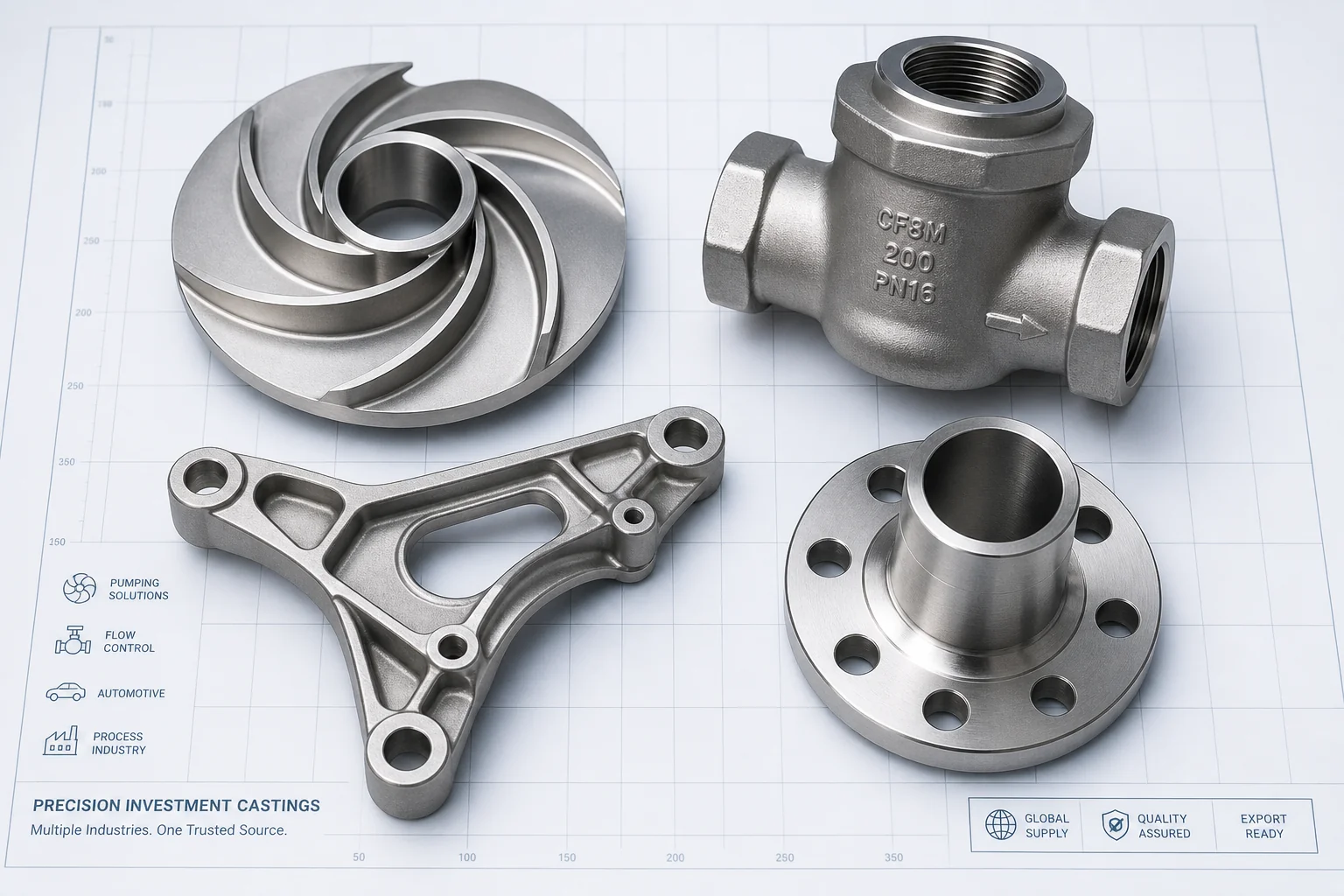
- Stainless steel (austenitic): CF8 (304), CF8M (316), CF3M (316L), corrosion-resistant pump, valve, and food-grade components
- Stainless steel (precipitation hardening): 17-4PH (CB7Cu-1), high-strength aerospace and defence components
- Duplex and super-duplex stainless: CD4MCu, CE8MN, offshore oil & gas, seawater applications
- Heat-resistant alloys: HH, HK, HT grades, furnace components, high-temperature industrial applications
Non-Ferrous Alloys
- Aluminium alloys: A356, A380, lightweight automotive and aerospace components
- Brass and bronze: C83600, C84400, C95400, marine, hydraulic, and architectural hardware
- Copper-based alloys: Electrical and thermal conductivity applications
German OEM engineering teams typically specify materials using DIN or EN designations. A qualified Indian foundry will cross-reference these to ASTM/AISI equivalents and provide material test certificates (MTCs) confirming chemical composition and mechanical properties to the specified standard. According to ASTM International, material traceability documentation is a baseline requirement for any precision casting supplied into regulated industries.
Quality Standards That Matter to German Procurement Teams
Quality assurance is the single most important factor when qualifying an overseas casting supplier. German OEMs operate under strict incoming quality requirements, and any supplier gap creates production risk. Here is what a credible Indian investment casting foundry should demonstrate.
ISO 9001:2015, Quality Management System
This is the baseline certification for any serious manufacturing supplier. ISO 9001 confirms that the foundry operates a documented, audited quality management system covering process control, non-conformance management, corrective action, and customer satisfaction. It is a prerequisite for most German Tier-1 and OEM supplier qualification processes.
ISO 14001:2015, Environmental Management
European supply chain sustainability requirements have tightened considerably. The EU's Corporate Sustainability Reporting Directive (CSRD) and supply chain due diligence regulations mean German OEMs must increasingly demonstrate that their suppliers meet environmental management standards. ISO 14001 certification confirms that the foundry has a structured approach to minimising environmental impact, including waste management, emissions control, and resource efficiency.
Wellmake Technocast's commitment to sustainable manufacturing, including renewable energy use and waste recycling, directly supports the ESG compliance requirements of European procurement teams. You can learn more about global environmental management standards at the ISO official resource on ISO 14001.
ISO 45001:2018, Occupational Health and Safety
Ethical sourcing policies at major German manufacturers now extend to worker safety at supplier facilities. ISO 45001 certification demonstrates that the foundry manages occupational health and safety risks systematically, a requirement for suppliers to companies with robust ESG and responsible sourcing commitments.
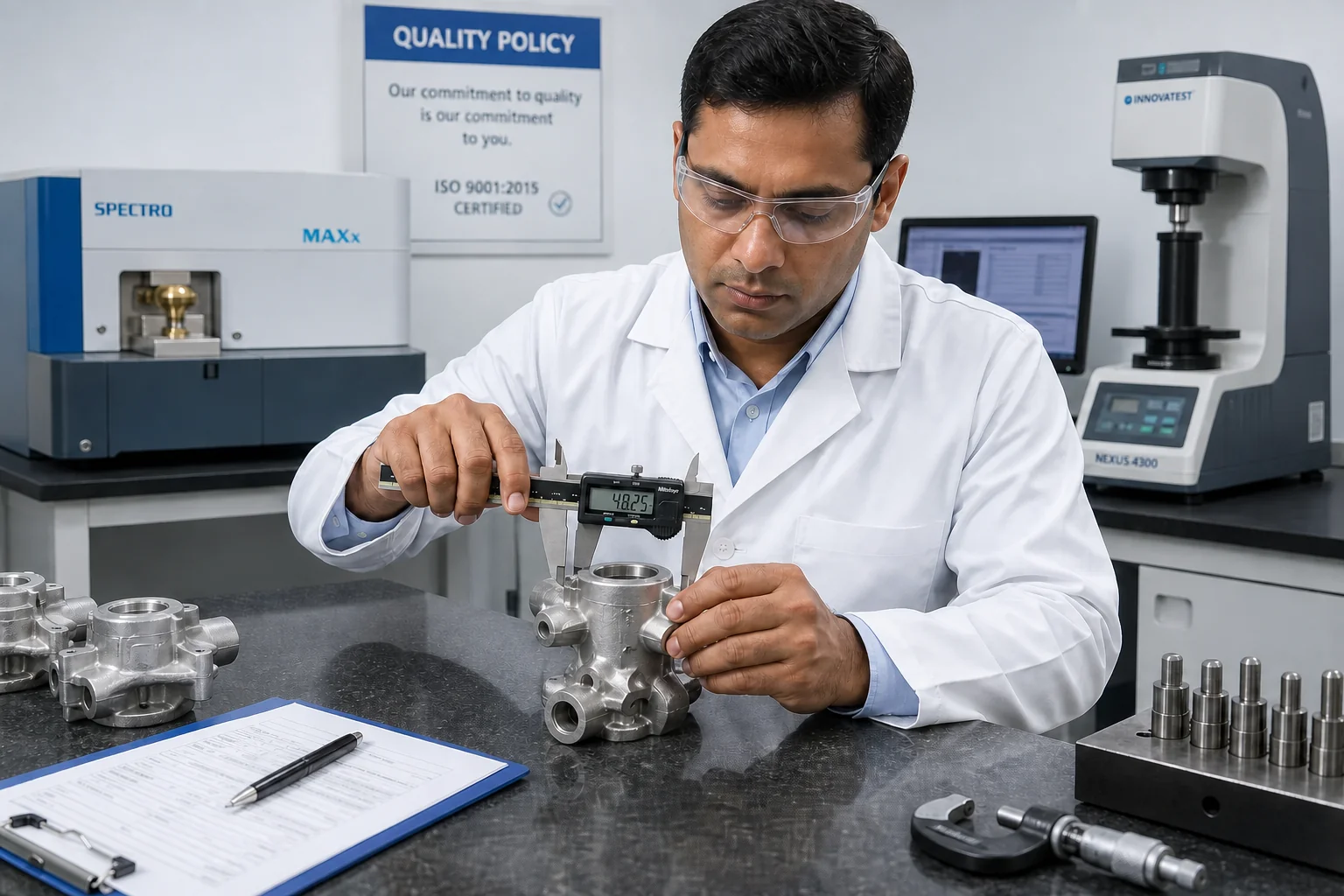
In-House Testing Capabilities
Certification alone is not sufficient. A credible foundry must have the in-house testing equipment to verify every batch before dispatch:
- Spectrometer: Chemical composition verification of each heat of metal
- Universal Testing Machine (UTM): Tensile strength, yield strength, and elongation testing
- Hardness Tester: Brinell, Rockwell, or Vickers hardness verification
- Impact Testing Machine (Charpy/Izod): Toughness verification for low-temperature and dynamic load applications
- Dimensional inspection: CMM, vernier calipers, gauges, and surface roughness testers
Each shipment should be accompanied by a material test certificate, dimensional inspection report, and heat treatment record (where applicable). German OEMs should request sample documentation during the supplier qualification stage to verify the format and completeness of quality records.
Industries and Component Types Served
A versatile investment casting foundry serves multiple industrial sectors, which matters to German OEMs who may source components across different product lines from a single supplier.
Automotive
Brackets, sensor housings, gear components, exhaust manifold fittings, and structural connectors. Investment casting delivers the tight tolerances and complex geometries required for modern automotive assemblies, with material options spanning carbon steel to aluminium alloys.
Pump & Valve
Impellers, pump casings, valve bodies, bonnets, and trim components. Stainless steel and duplex alloys are standard for corrosion-resistant pump and valve applications. Line-ready machined components with finished bore, face, and port dimensions are a common requirement in this sector.
Oil & Gas
Flanges, manifolds, choke bodies, wellhead components, and subsea fittings. High-pressure and corrosion-resistant alloys (duplex, super-duplex, Inconel) are frequently specified. Traceability and material certification requirements are particularly stringent in this sector.
Aerospace
Structural brackets, actuator housings, and non-rotating precision components. 17-4PH stainless and aluminium alloys are common. First-article inspection (FAI) and PPAP documentation are standard requirements for aerospace supply chains.
Railways & Defence
High-reliability components requiring certified materials, full traceability, and consistent mechanical properties. Investment casting's ability to produce complex geometries with minimal porosity makes it well-suited to safety-critical railway and defence applications.
Fire Safety
Valve bodies, fittings, and actuator components for fire suppression systems. Brass, bronze, and stainless steel are the primary materials. Dimensional consistency is critical for components that must function reliably in emergency conditions.
Orthopedic Implants
Biocompatible precision castings in titanium and cobalt-chrome alloys for medical device applications. This sector demands the highest levels of surface finish, dimensional accuracy, and material traceability.
To explore the full range of components available from Wellmake Technocast, browse the product catalogue, covering all major industrial sectors with both un-machined and machined supply options.
How to Evaluate and Onboard an Indian Investment Casting Supplier
Supplier qualification is a structured process. Rushing it creates quality risk; over-engineering it delays cost savings. Here is a practical seven-step onboarding framework for German OEM procurement teams.
Step 1: Define Your Component Requirements Precisely
Before approaching any foundry, prepare a complete technical package: 2D drawing with GD&T callouts, 3D CAD model (STEP or IGES format), material specification (DIN/EN or ASTM equivalent), surface finish requirements, heat treatment specification, and annual volume forecast. The more complete your RFQ package, the more accurate and comparable the quotations you receive.
Step 2: Verify Certifications and Audit Readiness
Request current ISO certificates (9001, 14001, 45001) and verify their validity with the issuing certification body. Ask whether the foundry has undergone customer audits from European OEMs previously, and request references. A foundry that welcomes remote or on-site audits is demonstrating confidence in its processes.
Step 3: Request Sample Castings and First-Article Inspection
Never approve a new casting supplier based on quotation alone. Request a sample run (typically 5, 10 pieces) and conduct a full first-article inspection (FAI) against your drawing. Review the dimensional report, material test certificate, and surface finish measurement. Any deviations should be formally documented and corrective actions agreed before production approval.
Step 4: Assess Production Capacity and Lead Time Commitments
Confirm the foundry's monthly production capacity and current utilisation. A foundry running at 95% capacity has little buffer for your volume ramp-up. Ask for typical lead times for tooling (new die manufacture) and production (first article and repeat orders). Tooling lead times of 4, 6 weeks and production lead times of 3, 5 weeks are typical for established Indian investment casting foundries.
Step 5: Evaluate Tooling Ownership and IP Protection
Clarify who owns the tooling (dies/moulds) once manufactured. In most B2B arrangements, the customer pays for tooling and retains ownership, meaning the tooling can be transferred to another foundry if the relationship ends. Confirm this in writing before tooling manufacture begins. Also verify that the foundry has confidentiality and IP protection policies in place for your component designs.
Step 6: Establish Quality Control Checkpoints
Agree on a quality control plan that specifies inspection frequency, inspection methods, and documentation requirements for each production batch. Define the acceptance criteria for critical dimensions and material properties. Establish a clear non-conformance management process, including how defective parts are identified, quarantined, and replaced.
Step 7: Negotiate Commercial Terms
Agree on Incoterms (FOB Mundra or CIF Hamburg are common for India-Germany shipments), payment terms, packaging specifications, and minimum order quantities. Ensure the commercial agreement includes provisions for price review, tooling maintenance, and dispute resolution. A long-term supply agreement (typically 1-3 years) provides both parties with the stability needed to invest in the relationship.
Frequently Asked Questions from German OEM Procurement Teams
What lead times should we expect for investment cast components from India?
Tooling (new die manufacture) typically takes 4, 6 weeks. First-article production and inspection adds another 3, 4 weeks. Repeat production orders for approved components generally run 4, 6 weeks from order confirmation, depending on complexity and volume. Sea freight from India to Germany adds approximately 20-25 days. Air freight is available for urgent requirements at higher cost.
Can an Indian foundry match DIN/EN material specifications?
Yes. Established Indian investment casting foundries routinely cross-reference DIN/EN material designations to ASTM/AISI equivalents and cast to those specifications. Material test certificates confirm chemical composition and mechanical properties. If your specification requires a specific DIN grade, provide the full designation and request confirmation of the ASTM equivalent the foundry will use, along with sample MTCs from previous production.
How is tooling (die/mould) ownership handled?
Standard practice is for the customer to pay a one-time tooling charge and retain ownership of the die. The foundry holds the tooling on-site for production use. If the relationship ends, the customer can request transfer of the tooling to another foundry. Always confirm this arrangement in writing before tooling manufacture begins.
What quality documentation is provided with each shipment?
A credible investment casting foundry should provide, as a minimum: material test certificate (MTC) with chemical composition and mechanical properties, dimensional inspection report, heat treatment certificate (where applicable), and a certificate of conformance. Additional documentation, such as radiographic inspection reports or dye penetrant test results, can be arranged for critical applications.
Is ESG-compliant sourcing possible from an Indian investment casting foundry?
Absolutely. ISO 14001 and ISO 45001 certifications are the baseline indicators of environmental and social governance compliance. Beyond certification, look for foundries that use renewable energy, operate waste recycling programmes, and can provide sustainability data for your supply chain reporting. ISO 45001 in particular is increasingly recognised by European OEMs as evidence of responsible sourcing from overseas suppliers.
Key takeaway for German OEM procurement teams: The combination of triple ISO certification, in-house testing capability, single-source supply (cast + machined), and 70 MT monthly capacity makes a qualified Indian investment casting foundry a genuinely competitive alternative to European suppliers, not just on cost, but on quality, compliance, and supply chain resilience.
Start Your Sourcing Conversation with Wellmake Technocast
Wellmake Technocast Pvt. Ltd. has been manufacturing and exporting precision investment cast components from Rajkot, India since 2005. With ISO 9001, ISO 14001, and ISO 45001 certifications, a 70 MT monthly production capacity, and the ability to supply both un-machined and fully machined line-ready components across ferrous and non-ferrous alloys, Wellmake is structured to meet the quality and compliance expectations of German OEM procurement teams.
Whether you are qualifying a new investment casting supplier for OEM components or looking to consolidate your casting and machining supply into a single reliable source, the right first step is a direct technical conversation. Share your component drawings, material specifications, and volume requirements, and receive a detailed quotation with full quality documentation.
Explore the full product range to see the component types and sectors Wellmake serves, or contact the team directly to begin your supplier qualification process. Precision, reliability, and long-term partnership, that is the Wellmake commitment to every OEM customer.