
Can Investment Casting Handle Complex Geometries?
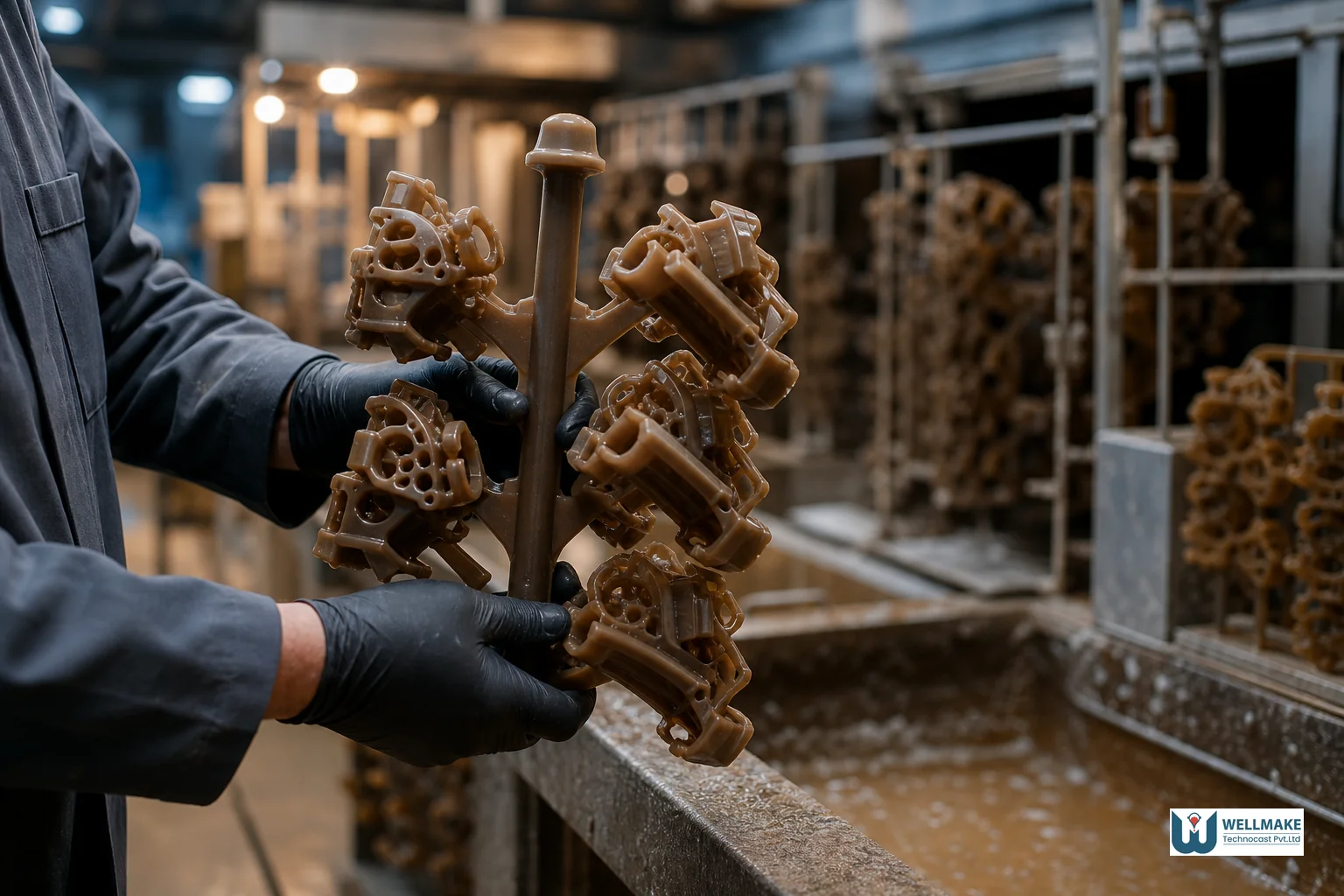
A design engineer at a valve manufacturer once sketched a single-piece multi-port body with three intersecting internal channels and a wall section barely 3mm thick. Her fabrication shop said it would need four separate machined pieces welded together. Her casting supplier said something different: pour it as one part. That conversation captures the exact question this article answers. Is investment casting suitable for complex geometries, or is that claim more marketing than metallurgy?
The short answer is yes, with important nuance. Investment casting, also called lost-wax casting, is one of the few metal-forming processes that can produce thin walls, internal passages, undercuts, and fine surface detail in a single near-net-shape part. But "complex" means different things to different engineers, and not every intricate feature is equally easy to cast. This guide breaks down what investment casting can and can't do with difficult geometries, how it compares to sand casting, die casting, and CNC machining, and how a single-source foundry like Wellmake Technocast turns complex drawings into line-ready components.
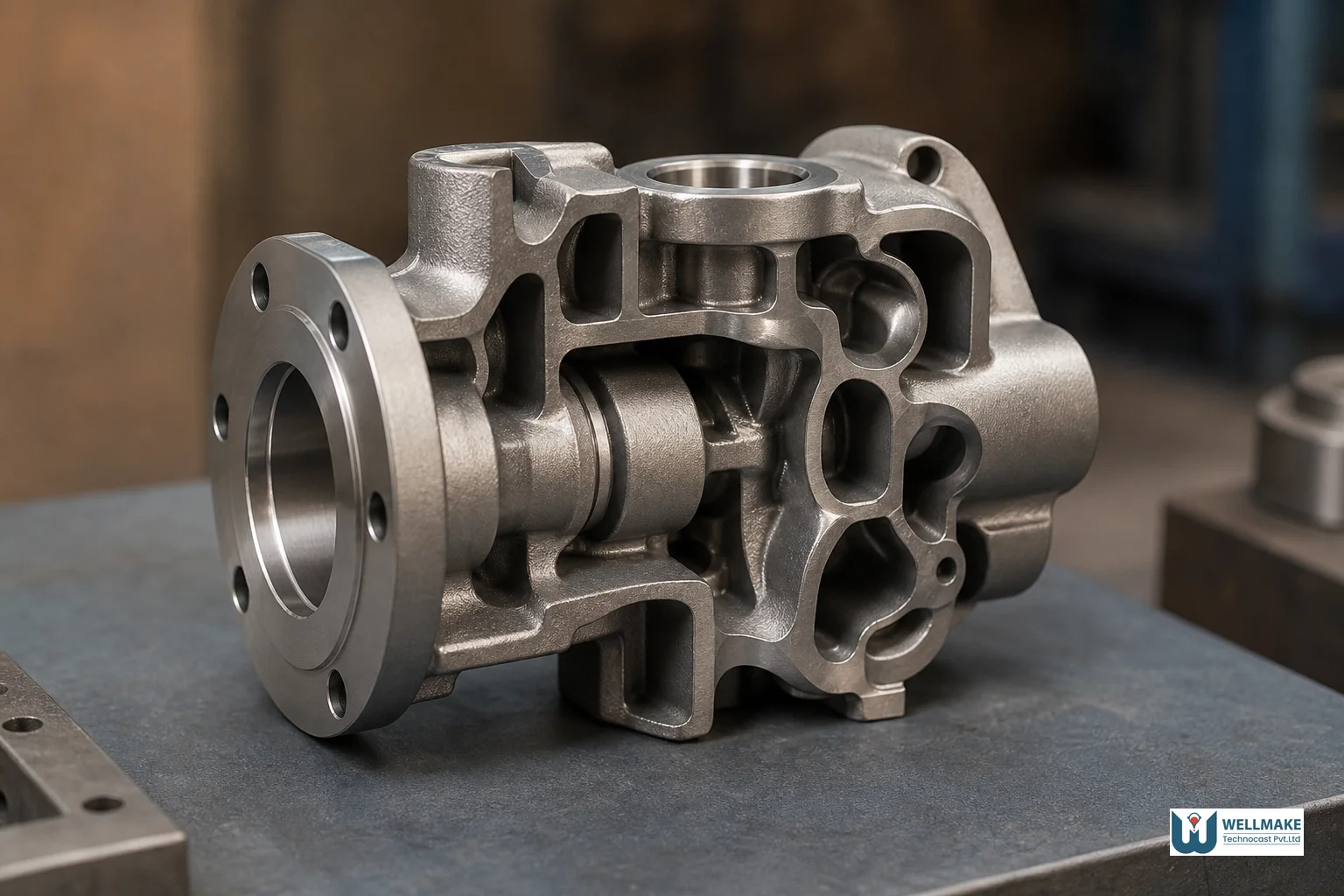
What Counts as a "Complex Geometry" in Casting Terms
Before comparing manufacturing methods, it helps to define terms. In casting and machining discussions, "complex geometry" usually refers to a combination of these features:
- Thin, variable-thickness walls — sections that change from 3mm to 15mm within the same part
- Undercuts and internal cavities — features that a straight-pull mold or a machine tool cannot reach directly
- Internal passages and cored channels, curved or branched fluid paths inside a solid-looking part
- Integrated bosses, flanges, and ribs, features that would otherwise require welding separate pieces together
- Fine surface detail, sharp edges, part numbers, or textured surfaces cast directly into the part
Each of these features causes a specific problem for other manufacturing methods. Sand casting struggles with thin walls because molten metal cools and solidifies before it fills a narrow section. Die casting struggles with undercuts because the hardened steel die needs to separate cleanly, which limits how much geometry can hang below the parting line. CNC machining struggles with internal passages, because a cutting tool physically cannot reach a curved channel buried inside solid stock. That's exactly where investment casting starts to look different.
How Investment Casting Achieves Geometric Freedom
The reason investment casting handles intricate shapes well comes down to the process itself. A wax pattern is injected or 3D printed into the exact shape of the finished part, including every internal detail. That pattern gets coated in layers of ceramic slurry to build a shell, then the wax is melted out, leaving a hollow ceramic mold that is an exact negative of the part. Molten metal fills that cavity and solidifies into the final shape.
Because the mold is built around a disposable wax pattern rather than a rigid, reusable die, there's no parting line constraint and no need for the part to release from a tool. This single difference unlocks most of the design freedom that makes investment casting attractive for complicated parts. If you want the full breakdown of each production stage, our article on how investment casting works step by step walks through the entire eight-stage process.
Practically, this means a foundry can cast:
- A valve body with three or four ports and internal flow passages as one solid piece, no welding required
- A bracket with a curved profile and variable wall thickness that a straight-pull die could never release
- A housing with an integrated mounting boss, rib, and flange combination in one pour
- Parts with wall sections as thin as 2 to 3mm in the right alloy and geometry combination
Tolerances also matter here. Because the cast shape is already close to the finished form, there's far less stock to remove afterward, and less risk of distorting a delicate feature during heavy machining. For a deeper look at what accuracy is realistically achievable, see our detailed guide on what tolerances investment casting can achieve.
Investment Casting vs Sand Casting vs Die Casting vs CNC Machining for Complex Parts
Every manufacturing method has a sweet spot. The table below compares how each one performs specifically on complex-geometry criteria, not just general cost or speed.
| Criteria | Investment Casting | Sand Casting | Die Casting | CNC Machining |
|---|---|---|---|---|
| Thin wall capability | Excellent (down to ~2-3mm) | Poor to fair (typically 6mm+) | Good for high-pressure alloys | Limited by tool access and part rigidity |
| Undercuts / internal cavities | Excellent, using ceramic cores | Fair, needs sand cores and extra labor | Poor, limited by die parting line | Very poor, tool cannot reach hidden cavities |
| Surface finish (as-cast) | Very good, reduces machining | Rough, usually needs finishing | Good on exterior surfaces | Excellent, but only on reachable surfaces |
| Dimensional tolerance | Tight (often ±0.1-0.4mm depending on size) | Loose, more machining allowance needed | Tight, but limited alloy choice | Tightest, but costly on complex forms |
| Tooling cost for complex shapes | Moderate, wax dies or 3D printed patterns | Low to moderate | High, hardened steel dies | Low tooling, high programming/cycle time |
| Best-fit production volume | Low to high (prototypes to thousands) | Low to medium, large parts | High volume only (economics demand it) | Low to medium, prototype-friendly |
| Part consolidation potential | High, multiple features in one pour | Moderate | Moderate | Low, usually machined from single billet |
Investment casting rarely wins on raw speed against die casting at extreme volumes, and it isn't the cheapest option for a simple bracket that a three-axis mill can knock out quickly. Where it wins decisively is the middle ground: parts that are geometrically demanding, need tight tolerances, and run in low-to-mid production volumes where die tooling investment doesn't make sense. If you're weighing this decision on cost terms specifically, our comparisons on investment casting versus machining costs and investment casting versus die casting costs go deeper into the numbers.
Real-World Examples: Complex Geometries Across Industries
Theory aside, complexity shows up differently depending on the industry. Here's how it plays out in sectors Wellmake Technocast regularly serves.
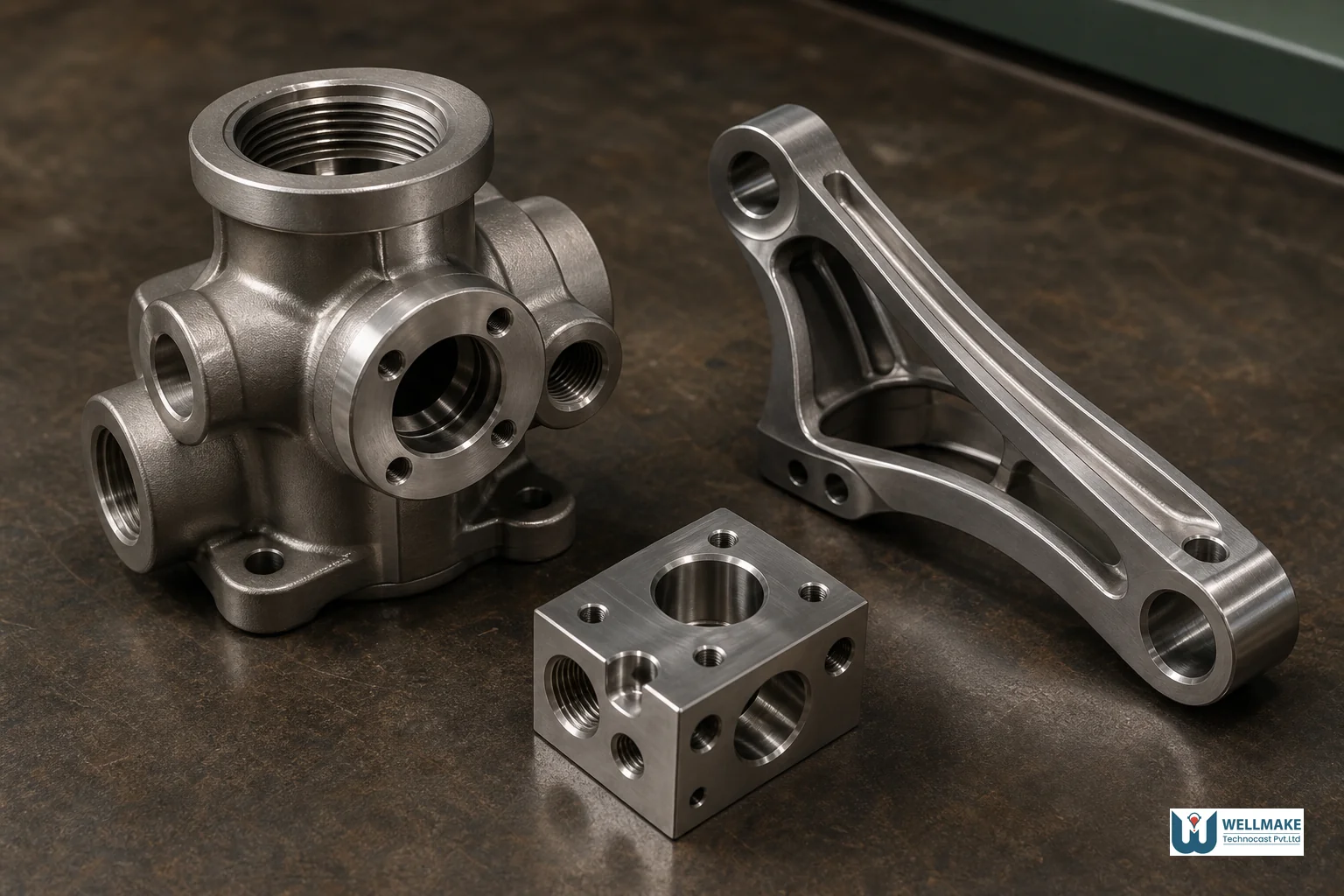
Pump & Valve: Multi-port valve bodies and pump volutes often need curved internal flow passages that match hydraulic performance requirements exactly. Casting these as one piece avoids weld seams that could become leak points or turbulence sources under pressure. This is one of the most common reasons pump and valve OEMs move away from fabricated assemblies toward cast bodies.
Aerospace: Structural brackets and housings near engine or landing gear assemblies frequently combine thin walls for weight savings with tight tolerance mounting faces. A single casting that integrates ribs and bosses reduces both weight and the number of fasteners needed, which matters for both certification and long-term fatigue performance.
Oil & Gas: Flow-control bodies and small manifold blocks often need multiple intersecting bores at different angles. Machining these from solid bar stock means deep-hole drilling at odd angles, which is slow and risks tool breakage. Casting the rough passages first, then finish-machining only the critical sealing surfaces, cuts both cost and risk.
Railways & Defence: Housings and brackets in this sector often need integrated mounting features and must meet strict material traceability and testing standards. Casting these as single parts reduces the number of joints that need inspection, which simplifies the certification paperwork significantly.
Across all four sectors, the common thread is the same: complexity that would otherwise mean multiple parts, welds, or difficult machining operations gets consolidated into one cast component.
Design Features Investment Casting Handles Well
To make this concrete, here's a practical list of geometric features that investment casting routinely handles without exotic tooling or excessive cost:
- Thin walls: Sections down to 2-3mm are achievable in many alloys, especially stainless and nickel-based steels, provided the pattern and gating are designed correctly.
- Undercuts and internal cavities: Ceramic and soluble core technology allows hollow or curved internal features that would trap a die or block a cutting tool.
- Curved or branched internal passages: Flow paths for valves, pumps, and manifolds can be cast directly rather than gun-drilled.
- Fine surface detail: Part numbers, logos, and textured surfaces can be cast in, cutting a secondary marking step.
- Tight tolerances on critical features: Because less stock needs removing, delicate thin sections are less likely to warp during machining.
- Part consolidation: Combining what used to be three or four welded pieces into a single casting removes weld inspection points and reduces overall assembly time.
The real value of investment casting on complex parts isn't just that it can make the shape. It's that it can make the shape as one piece, with fewer joints, fewer inspection points, and less variability from operator to operator.
Where Investment Casting Has Limits
No process is right for everything, and an honest answer to "is investment casting suitable for complex geometries" has to include where it falls short.
- Very large thin-wall structures: Big shell-like parts with expansive thin sections sometimes suit sand casting better, since shell size and pouring dynamics become the limiting factor rather than detail.
- Ultra-high volume simple shapes: If a part geometry is genuinely simple and volumes run into the hundreds of thousands, die casting's speed usually wins on unit economics.
- Extremely deep blind holes: Some very deep, small-diameter blind holes are still easier to finish with secondary drilling rather than casting them net-shape.
- Patterns that trap ceramic core material: Certain enclosed geometries make core removal difficult after casting, so design-for-manufacture review is important before committing to a shape.
Being upfront about these boundaries matters. A foundry that says "yes" to every geometry without a design-for-manufacturability conversation is a foundry worth questioning. Our article on red flags to avoid when sourcing from a foundry covers this in more detail if you're currently vetting suppliers.
How Wellmake Technocast Handles Complex, Machined-Ready Components
Wellmake Technocast has produced precision investment castings from its Rajkot, Gujarat facility since 2005, working across ferrous and non-ferrous alloys for Automotive, Aerospace, Pump & Valve, Oil & Gas, Mining, Railways & Defence, and Fire Safety customers. Complex geometry is not an exception in this work; it's the daily baseline, since most industrial buyers approach investment casting specifically because a simpler process couldn't produce their part.
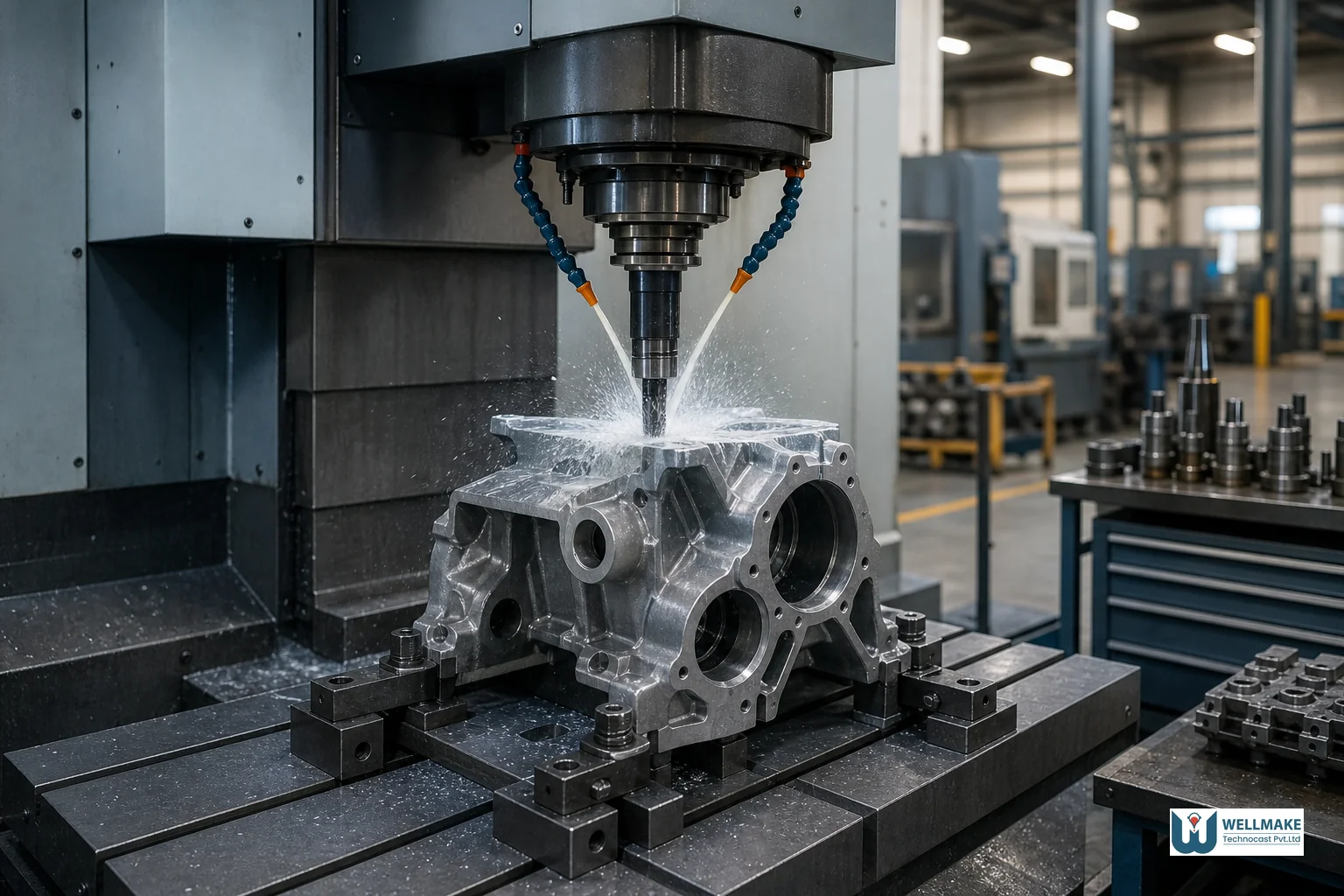
What sets a single-source foundry apart on complex parts is what happens after the pour. A raw casting with intricate internal passages still needs critical surfaces finished to line-ready tolerance, and handing that job to a separate machine shop introduces a second point of failure and a second supplier relationship to manage. Wellmake Technocast keeps both stages in-house: the eight-step ceramic shell casting process and precision CNC finishing, so a complex part arrives ready for assembly rather than needing another vendor in the loop.
A few operational facts back this up:
- 70 MT monthly production capacity, handling components from a few grams up to 180 kg, which covers everything from small valve trim to substantial pump housings
- In-house quality control using spectrometers, universal testing machines, hardness testers, and impact testing equipment, which matters most on complex parts where a hidden defect in a thin wall or internal passage is harder to spot visually
- ISO 9001, ISO 14001, and ISO 45001 certification, reflecting the process discipline needed to hold consistent quality on intricate geometries batch after batch, not just on a single sample part
- Sustainable manufacturing practices, including renewable energy use and waste recycling in production
These aren't abstract credentials. Complex geometries amplify the consequences of process drift. A minor shift in shell thickness or pour temperature that would barely register on a simple bracket can show up as a wall thickness variance or porosity in a thin-walled valve body. That's why process control, testing equipment, and certified quality systems matter more, not less, as geometry gets harder.
If you want to see the breadth of parts this covers, you can explore Wellmake Technocast's product range across pump and valve components, oil and gas fittings, aerospace brackets, and railway and defence housings.
Questions to Ask Before Sourcing a Complex Cast Component
If you're evaluating a foundry for a geometrically demanding part, a few pointed questions separate a capable partner from one that's guessing:
- What is your minimum wall thickness for this alloy and part size? Ask for real production data, not a marketing brochure figure.
- How do you handle internal passages or undercuts in this design? A specific answer about core material and removal method is a good sign; a vague answer is not.
- Can you share tolerance data from a similar past part? Not a spec sheet claim, but actual first-article inspection results.
- Do you offer machining in-house, or will this go to a third party? Every handoff between vendors adds lead time and risk on complex parts.
- What does your first article inspection process look like? Complex geometries need more thorough dimensional checks than simple shapes.
- What's your realistic sample and production lead time for this specific complexity level? Complex parts often take longer to tool and prove out than simple ones.
For a broader supplier vetting framework, see our guides on how to qualify an overseas investment casting supplier and how to choose the right investment casting foundry. Both cover due diligence steps that matter even more once geometry gets complicated.
FAQ: Investment Casting and Complex Geometries
Can investment casting replace multi-part welded assemblies?
Often, yes. Many valve bodies, brackets, and housings that used to be welded from separate machined pieces can be redesigned as a single casting. This removes weld inspection points and can improve structural consistency, though it requires early design-for-manufacture input from the foundry.
What is the thinnest wall investment casting can produce?
It depends on alloy and part size, but walls in the 2 to 3mm range are achievable for many stainless steel and alloy steel parts, especially when the section isn't too large in area. Extremely thin walls over a large surface can still be risky and usually need a specific design review.
Does more complex geometry always mean higher cost?
Not necessarily in the way people assume. Complex geometry can raise pattern and tooling costs slightly, but it often lowers total part cost when compared to a machined or welded alternative, because it eliminates secondary operations, fixturing, and assembly labor.
Can investment casting achieve internal channels without secondary machining?
Yes, using ceramic or soluble cores placed inside the wax pattern before shell building. The core creates the internal cavity during the pour and is removed afterward, leaving the channel intact without drilling.
How does complexity affect achievable tolerance?
Simple, symmetric shapes generally hold tighter tolerances more consistently than highly asymmetric or thin-walled ones, since uneven cooling can introduce minor distortion. A capable foundry accounts for this in pattern design and shell engineering rather than leaving it to chance.
According to the Investment Casting Institute, the lost-wax process remains one of the few net-shape metal forming methods capable of producing complex, thin-walled parts with minimal secondary machining, a capability documented across decades of industrial use. For broader manufacturing standards context, the U.S. Department of Commerce tracks precision manufacturing trends relevant to OEMs sourcing globally.
So, is investment casting suitable for complex geometries? For the vast majority of intricate industrial parts, especially those combining thin walls, internal passages, and tight tolerances, the answer is a confident yes, provided the foundry has the process control and testing infrastructure to back it up. If you have a challenging drawing sitting in a folder because a previous supplier said "we can't cast that," it's worth a second opinion. Get in touch with Wellmake Technocast to share your design and get honest feedback on manufacturability, tolerance expectations, and realistic lead time before you commit to tooling. For OEMs and engineering teams ready to move a complex part from concept to line-ready component, contact us today to start the conversation.