
How to Audit a Casting Supplier Before You Order

A procurement engineer at a fire pump manufacturer once skipped a factory audit because the supplier's sample part looked flawless and the quote was 20% below budget. Four months later, a 300-piece batch arrived with inconsistent wall thickness and no material test certificates to explain why. Knowing how to audit a casting supplier before ordering is what separates buyers who catch that problem on paper from buyers who catch it on the assembly line.
Key Takeaways
- Audit before the PO, not after the first batch fails: a factory audit costs a few hours of review; a failed production batch costs weeks of rework and re-qualification.
- Triple ISO certification is the baseline: ISO 9001 (quality), ISO 14001 (environmental), and ISO 45001 (occupational health and safety) should all be current and verifiable, not just listed on a website.
- Lab equipment determines what gets caught before shipping: a spectrometer, Universal Testing Machine (UTM), hardness tester, and impact testing machine are the minimum in-house toolkit for catching defects pre-dispatch.
- Capacity must match your order profile: a foundry's monthly tonnage capacity (for example, 70 MT) and component size range need to comfortably cover your batch size, not sit at its ceiling.
- Traceability closes the loop: every casting should be traceable to a heat number, shell batch, and inspection record, so a defect can be root-caused instead of guessed at.
Audit Snapshot: What to Check and Why It Matters
| Audit Area | What to Check | Red Flag | Why It Matters |
|---|---|---|---|
| Certifications | Valid ISO 9001, 14001, 45001 certificates with current expiry dates | Certificate number can't be verified with the issuing body | Confirms a documented quality, environmental, and safety management system exists |
| Testing Lab | Spectrometer, UTM, hardness tester, impact tester on-site | Testing outsourced with no calibration records | Determines if defects are caught before your parts ship |
| Production Capacity | Monthly tonnage output vs. your order size and repeat cadence | Vague answers on furnace count or lead time | Prevents your order from overwhelming their schedule |
| Process Documentation | Step-by-step process map with in-process inspection points | No traceability by heat or batch number | Allows root-cause analysis if a defect appears later |
| Component Range | Minimum and maximum part weight the foundry regularly casts | Your part size is at the extreme edge of their stated range | Casting quality often degrades near a foundry's capability limits |
| Sustainability | Renewable energy use, waste/scrap recycling program | No documentation, only verbal claims | Increasingly required for EU and defence-sector procurement compliance |
| Sample & Documentation | First article inspection report, material test certificate | Refuses to provide a documented sample batch report | Confirms actual performance, not just marketing claims |
Sourcing castings from an unaudited foundry is one of the most common ways OEMs end up with inconsistent tolerances, failed hydrostatic tests, or components that don't match the material test certificate on file. This guide walks through exactly what an experienced procurement team checks before signing a purchase order with any investment casting supplier, whether local or overseas.
1. Start With the Paper Trail: Certifications That Actually Matter
Certifications are the fastest way to filter a supplier list before you invest time in a deeper audit. Not every certificate carries the same weight, though, and a logo on a website tells you nothing about whether the certificate is current or applies to the scope of work you need.
ISO 9001 confirms the foundry runs a documented quality management system: process controls, corrective action procedures, and traceability requirements. Without it, consistency between batch one and batch ten is largely a matter of luck. ISO 14001 covers environmental management, which matters both for regulatory compliance in your home market and because foundries with poor environmental controls often cut corners elsewhere too. ISO 45001 governs occupational health and safety; a foundry with high injury rates typically has higher staff turnover, which directly affects consistency in a labor-intensive process like ceramic shell building.
Ask for the certificate number and issuing body, then verify it independently rather than trusting a PDF sent by email. If your components are destined for pressure equipment, aerospace, or defence programs, also confirm sector-specific credentials such as PED compliance or NADCAP-aligned process controls where applicable. Wellmake Technocast holds all three ISO certifications (9001, 14001, and 45001), which buyers can and should verify directly rather than taking on faith.
For a deeper look at what happens when this step gets skipped, see our guide on red flags to avoid when sourcing from a foundry.
2. Inspect the Quality Testing Lab, Not Just the Sales Deck
A foundry can claim tight tolerances and clean metallurgy all day in a sales presentation. What actually catches a defect before it ships is the equipment sitting on the lab floor. This is the single most overlooked step in supplier audits, and it's the one most likely to expose the gap between marketing and reality.
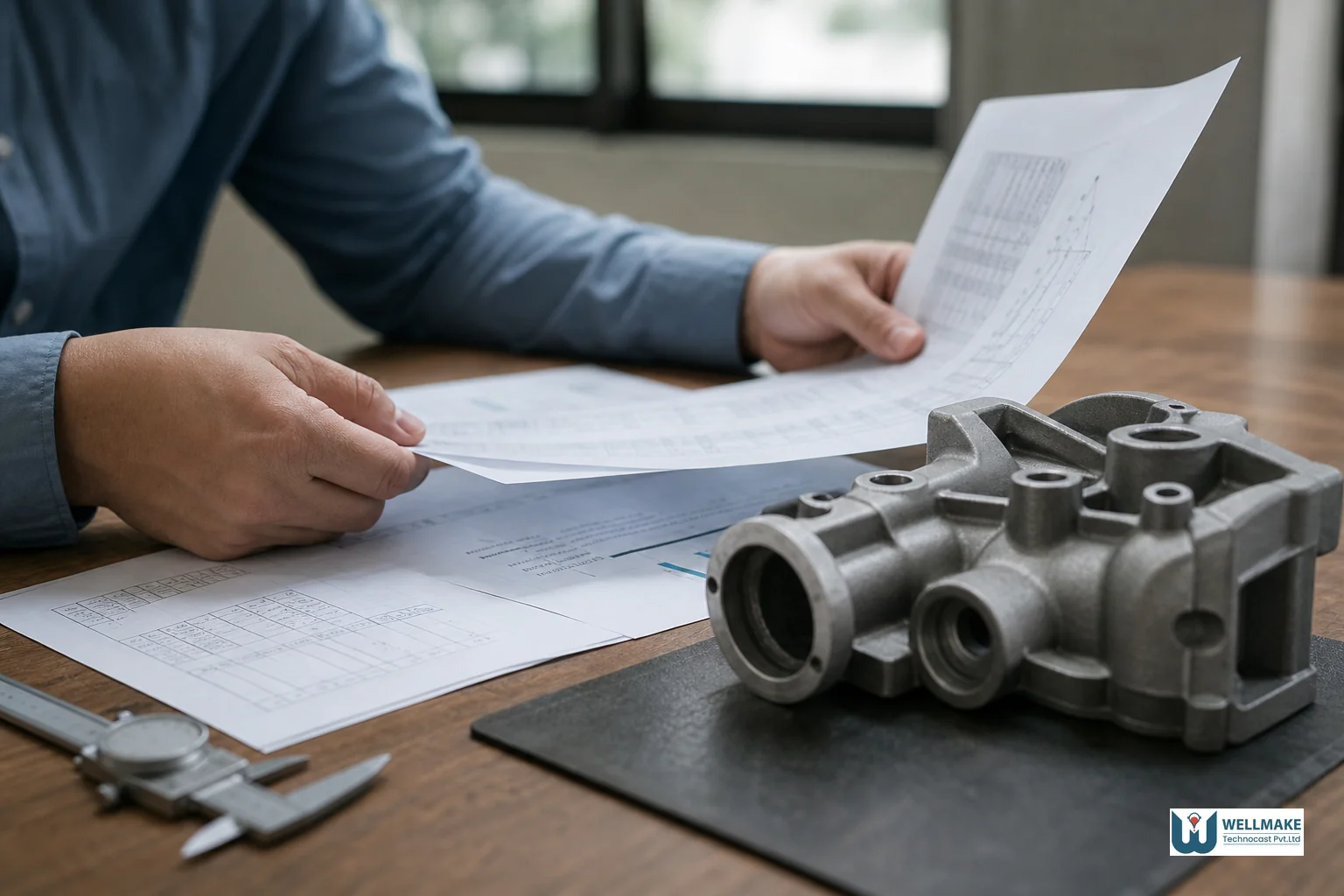
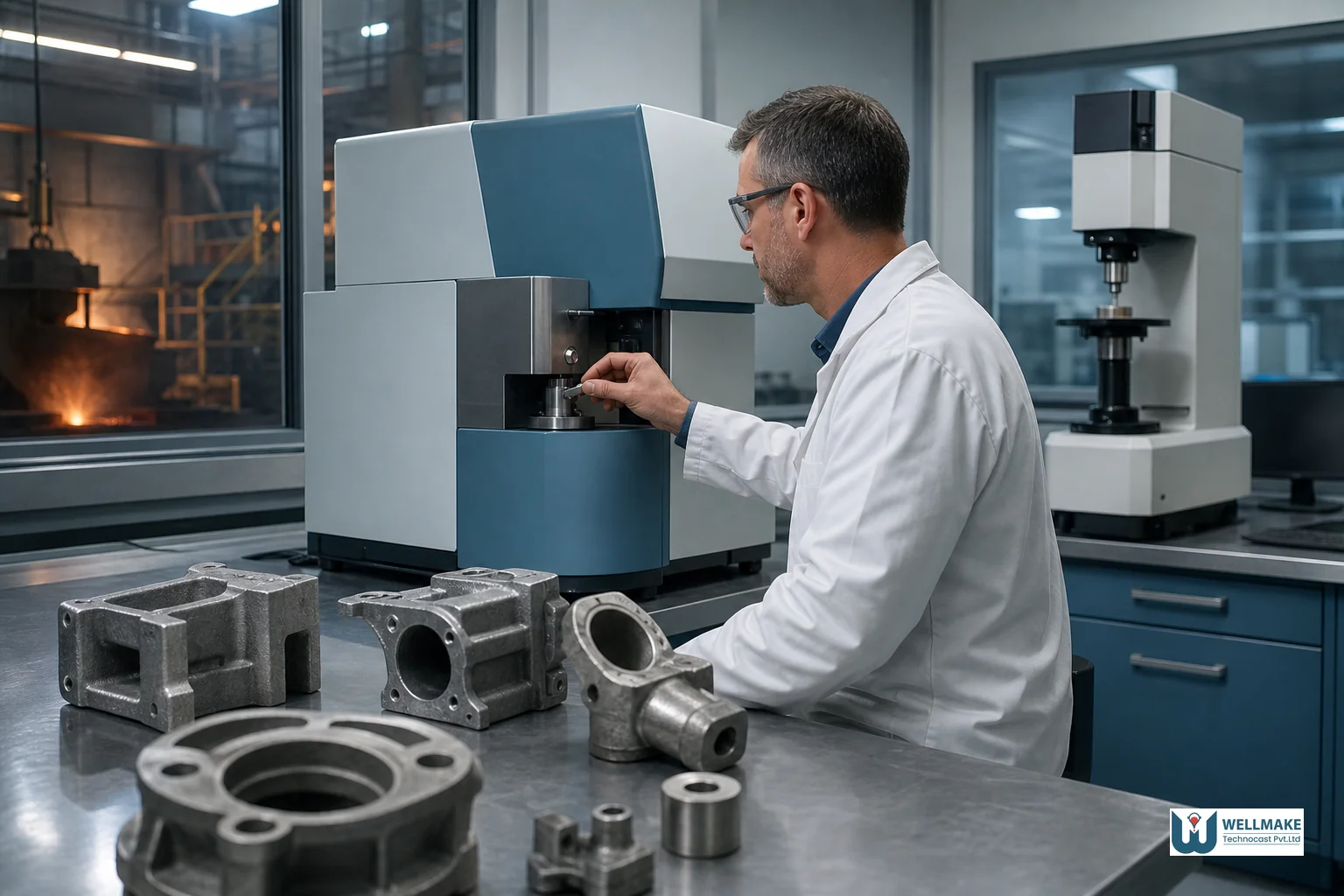
At minimum, confirm the supplier has a spectrometer on-site to verify chemical composition against the material grade you specified. Without one, you're trusting a mill certificate that may not reflect the actual pour. A Universal Testing Machine (UTM) confirms tensile strength and yield properties match the spec sheet. A hardness tester and an impact testing machine round out the core toolkit, particularly for components going into pump, valve, or oil and gas service where brittleness under load is a real failure mode.
Beyond the equipment list, ask three specific questions during the audit:
- Can you show me calibration certificates for this equipment, dated within the last 12 months?
- Can you provide a sample test report from a recent production batch, not just a demo part?
- Do you perform radiography, dye penetrant, or ultrasonic testing in-house, or is it outsourced?
A supplier that hesitates on any of these three questions is telling you something important. Wellmake's in-house lab covers spectrometer analysis, UTM testing, hardness testing, and impact testing as standard practice on production runs, not as a special request. If you're comparing quality control rigor across suppliers, our post on how to evaluate casting quality from overseas foundries covers additional inspection criteria worth adding to your checklist.
3. Verify Production Capacity Matches Your Order Profile
Capacity mismatches cause more delivery failures than almost any other factor, and they rarely show up until the second or third order. A foundry can produce a beautiful sample part in a job-shop setting and still struggle to hold consistency once your order competes with five other customers for furnace time.
Ask directly for the foundry's monthly tonnage capacity and compare it against your batch size and expected repeat order frequency. A foundry running near its ceiling on your first order has little room to absorb a rush request or a second customer's competing deadline. Wellmake operates at a 70 MT monthly capacity, casting components ranging from a few grams up to 180 kg, which gives buyers headroom for both small precision runs and larger structural components without straining the schedule.
Also confirm the number of furnaces in operation and whether they run on a shift pattern that supports your delivery timeline. A foundry with a single furnace and no backup is one unplanned maintenance event away from missing your date. If capacity questions are part of a broader cost comparison you're running, our article on investment casting vs machining: which costs less is a useful companion read for budgeting alongside capacity planning.
4. Walk the Process: From Wax Pattern to Finished Casting
Understanding the actual production sequence lets you ask sharper audit questions instead of accepting generic reassurances. Investment casting typically runs through eight stages: wax pattern creation, pattern assembly into a tree, ceramic shell building, dewaxing, shell firing, metal pouring, shell removal, and finishing or machining.
Each stage is a place where quality either gets built in or gets lost. Ceramic shell building, for example, requires consistent dip counts and drying times; rush this step and you get shell cracking or inclusion defects that only show up after machining, when it's expensive to discover. Ask the supplier to walk you through their in-process inspection checkpoints: do they check shell thickness before firing? Do they verify pour temperature and record it against a heat number?
Traceability is the piece that ties this all together. Every finished casting should be traceable back to its heat number, shell batch, and the specific inspection records tied to that batch. If a defect surfaces in the field six months later, this is what lets a supplier (and your own quality team) pinpoint the cause instead of guessing. For a full walkthrough of each production stage, our guide how does investment casting work, step by step breaks down the process in more technical detail.
If you need machined, line-ready components rather than raw castings, also confirm the foundry's in-house machining capability. A single-source supplier that handles both casting and finish machining removes a handoff point where dimensional drift commonly creeps in.
5. Check Sustainability and Compliance Practices
Environmental and social governance requirements have moved from a nice-to-have to a procurement gate for many European and North American buyers, particularly in defence, rail, and public infrastructure programs. This is where ISO 14001 stops being a checkbox and becomes a practical due-diligence item.
Ask the supplier how they manage furnace emissions, scrap metal recycling, and energy sourcing. A foundry using renewable energy for a meaningful share of its melting operations and running a formal scrap recycling program is generally further along in operational discipline overall, which tends to correlate with better process control elsewhere too. Wellmake runs its operations with renewable energy inputs and a structured waste recycling program alongside its ISO 14001 certification, an approach increasingly requested by procurement teams in EU markets with strict environmental reporting requirements.
ISO 45001 compliance matters here too, though for a less obvious reason: foundries with weak safety records tend to have higher staff turnover on the shop floor, which directly undermines the tacit skill and consistency that ceramic shell building and pouring depend on. A safe, stable workforce is a quiet but real quality indicator.
6. Request Documentation Before You Commit
Before any purchase order goes out, request four specific documents. This is the paperwork stage of the audit, and it's non-negotiable regardless of how strong the factory tour felt.
- Material Test Certificates (MTC): confirm chemical composition and mechanical properties for the actual heat used, not a generic spec sheet.
- First Article Inspection (FAI) report: a full dimensional report on the first production-representative part, ideally cross-referenced against your drawing's GD&T callouts.
- Sample batch with dimensional data: not just a single hero part, but a small batch showing consistency across pieces.
- References from your sector: ask for evidence of prior work in pump and valve, oil and gas, or railways and defence, depending on your industry, since process discipline requirements differ meaningfully by sector.
A supplier confident in their process will hand these over without friction. Hesitation, incomplete data, or a request to "trust the sample" instead of documentation is itself useful information. If you're weighing a new overseas supplier against your current domestic option, our guide on how to qualify an overseas investment casting supplier pairs well with this documentation checklist.
7. Red Flags That Should Stop an Order
Some findings during an audit should pause the process entirely, regardless of how attractive the quote looks. Watch for these specific warning signs:
- Reluctance to share the lab equipment list or calibration records, especially when asked a second time politely.
- Certificates that can't be independently verified with the issuing certification body's own registry.
- Vague or shifting answers on monthly capacity, current furnace utilization, or realistic lead times.
- No traceability system linking finished parts back to heat numbers or shell batches.
- Sample parts that look excellent but no batch consistency data to back up repeatability at volume.
- Environmental or safety claims with no supporting certification, particularly relevant if your own compliance program requires supplier ESG documentation.
Any single flag might have a reasonable explanation. Two or more together are a strong signal to keep looking, even if it means a longer sourcing cycle. The cost of requalifying a supplier after a failed batch almost always exceeds the cost of a thorough audit up front, a point covered in more depth in how to choose the right investment casting foundry.
Frequently Asked Questions
How long does a casting supplier audit typically take?
A document and certification review can be done in a few days. A full audit including a factory visit or detailed video walkthrough, sample evaluation, and lab report review usually takes two to four weeks, depending on how quickly the supplier provides documentation. Building this time into your sourcing schedule upfront avoids rushed decisions later.
Can I audit an overseas casting supplier without visiting in person?
Yes, though it requires more structured documentation requests. Video walkthroughs of the foundry floor and testing lab, digitally verified certification numbers, and third-party inspection reports on a sample batch can substitute for an in-person visit, particularly for a first qualifying order. Many buyers combine remote audits with a third-party inspection agency for the first production batch as an added checkpoint.
What's the difference between auditing and qualifying a supplier?
An audit is the evaluation process itself, reviewing certifications, lab capability, and documentation. Qualification is the outcome: a formal decision that the supplier meets your organization's standards to receive production orders. Most industrial buyers run an audit first, then a qualification trial order, before releasing full production volume.
Do I need to re-audit a supplier for repeat orders?
A lighter-touch review makes sense annually or when there's a material, process, or facility change at the foundry. Full audits aren't usually needed for every repeat purchase order, but spot-checking material test certificates and dimensional reports on each incoming batch remains good practice regardless of how long you've worked with a supplier.
Which certifications should I prioritize if I can only verify a few?
ISO 9001 is the non-negotiable baseline for any casting supplier. If your components go into pressure-retaining or safety-critical applications, prioritize verifying sector-specific quality requirements next, then confirm ISO 14001 and 45001 if your own organization has environmental or ethical sourcing reporting obligations, as is increasingly common for buyers in Germany, Sweden, and the broader EU.
The cheapest quote and the most consistent supplier are rarely the same foundry. A structured audit is how you find out which one you're actually looking at before the purchase order is signed.
Auditing a casting supplier before you order isn't a bureaucratic delay, it's the step that prevents inconsistent batches, failed inspections, and re-qualification cycles down the line. Certifications, lab equipment, documented capacity, and traceable process controls are the four pillars that separate a dependable long-term supplier from a costly gamble. Wellmake Technocast holds ISO 9001, 14001, and 45001 certifications, runs an in-house testing lab with spectrometer, UTM, hardness, and impact testing equipment, and operates at a 70 MT monthly capacity across ferrous and non-ferrous alloys, benchmarks built specifically for buyers running exactly this kind of audit.
If you're ready to see how these standards apply to your specific components, explore Wellmake's product range across pump and valve, oil and gas, railways and defence, and general engineering applications. For teams looking to compare capacity, certifications, or lead times against their current supplier, get in touch with our engineering team for a documented capability review before your next purchase order goes out. Auditing thoroughly now is far less costly than requalifying a supplier after a failed batch, so contact us today to start that review.