
Investment Casting vs Sand Casting: Italy Guide
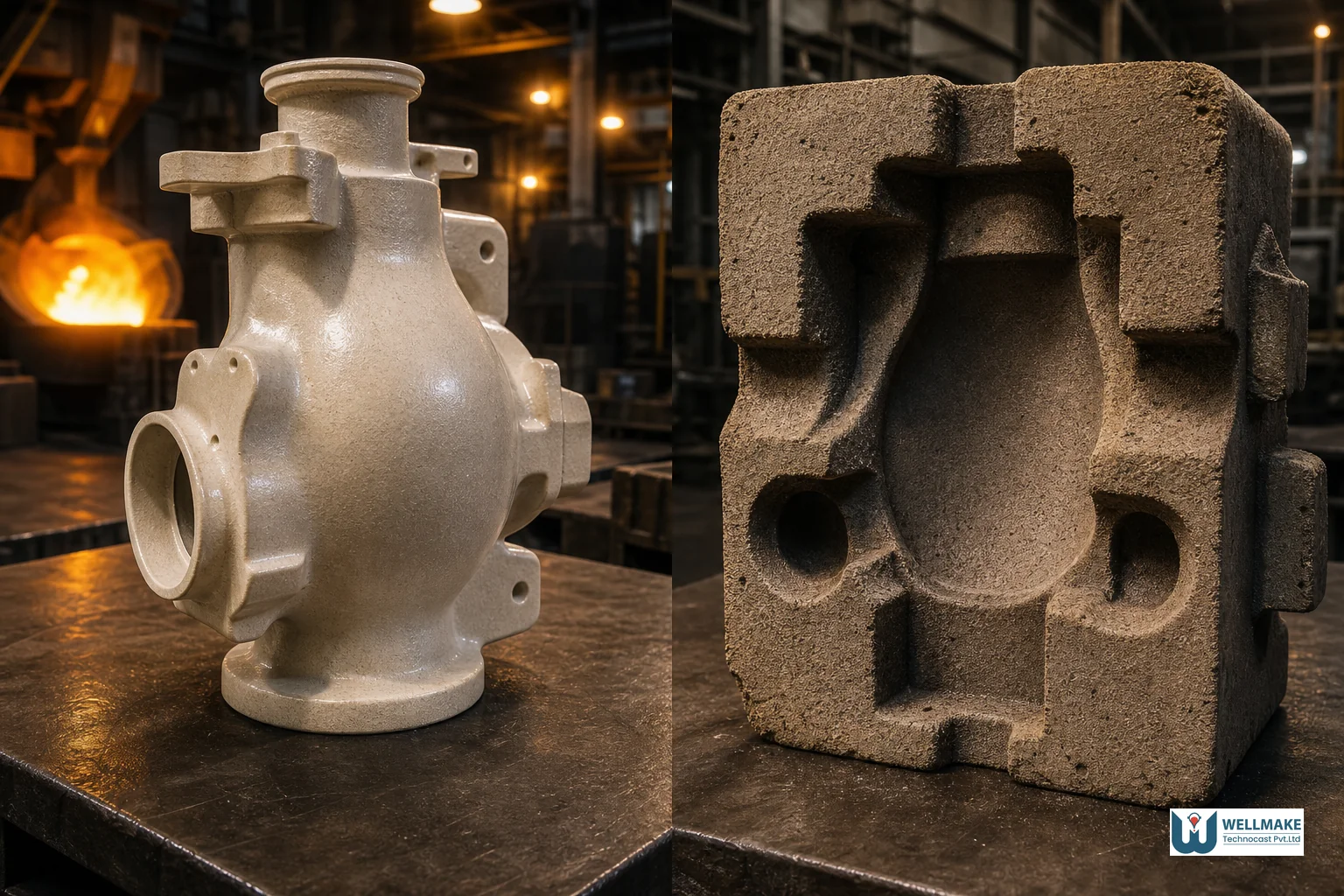
Picture a procurement engineer at a northern Italian OEM — a manufacturer of pump assemblies for the petrochemical sector — holding two sample components. One came from a local sand casting foundry. The other arrived from an ISO-certified investment casting supplier in India. Same alloy. Same nominal geometry. But the investment cast part required zero secondary machining, while the sand cast version needed three additional operations before it could go to assembly. The cost difference, once machining was factored in, was substantial.
That scenario plays out regularly across Italy's industrial heartland, from the pump and valve clusters of Lombardy to the oil and gas equipment manufacturers of Emilia-Romagna. Choosing between investment casting and sand casting is not simply a process decision; it is a total-cost-of-ownership decision that affects machining budgets, scrap rates, lead times, and ultimately, the competitiveness of the finished product.
This guide breaks down both processes head-to-head, with specific relevance for Italian industrial manufacturers and OEM procurement teams evaluating precision component sourcing.
Two Processes, One Critical Decision for Italian Manufacturers
Italy's manufacturing sector is among the most technically demanding in Europe. Sectors such as pump and valve production, oil and gas equipment, automotive components, and industrial machinery all require metal parts that meet tight dimensional tolerances, consistent surface quality, and reliable mechanical properties. The casting process chosen at the design stage locks in much of the downstream cost.
Sand casting has served Italian industry for generations. It is familiar, widely available domestically, and capable of producing large, simple components at relatively low tooling cost. Investment casting, by contrast, is a more capital-intensive process that delivers significantly higher dimensional accuracy, better surface finish, and far greater design freedom, particularly for complex, near-net-shape components.
The question is not which process is universally superior. The question is which process is right for your specific component, volume, and quality requirements, and whether the total cost, including post-casting machining and scrap, actually favours the option that looks cheaper on the quotation.
How Each Process Works: A Technical Overview
Investment Casting (Lost-Wax Process)
Investment casting begins with a precision wax pattern, typically injected into a metal die. Multiple wax patterns are assembled onto a central wax runner system, called a tree, and then repeatedly dipped into a ceramic slurry and coated with fine refractory sand to build up a ceramic shell. Once the shell reaches the required thickness, the wax is melted out (the "lost-wax" step), leaving a hollow ceramic mold. Molten metal is poured into this mold, and after solidification, the ceramic shell is broken away to reveal the casting.
The result is a component with excellent surface detail, tight dimensional tolerances, and minimal draft angle requirements. Because the ceramic mold is destroyed after each use, every casting is produced from a fresh mold, which is why the process achieves such consistent accuracy.
Sand Casting
Sand casting uses a reusable pattern (typically wood, plastic, or metal) pressed into a sand mixture to create a mold cavity. The two halves of the mold are assembled, molten metal is poured in, and after solidification, the sand is broken away. The pattern can be reused many times, which keeps tooling costs low.
The trade-off is surface quality and dimensional precision. Sand molds are inherently coarser than ceramic shells, and the process requires draft angles and parting lines that limit geometric complexity. Most sand castings require significant post-casting machining to reach final dimensions and surface finish specifications.
Dimensional Accuracy and Surface Finish: Where the Gap Is Largest
For Italian OEMs specifying components to DIN, ISO, or customer-specific engineering standards, dimensional accuracy is non-negotiable. This is where the two processes diverge most sharply.
Investment Casting Tolerances and Surface Finish
Investment casting typically achieves casting tolerances in the range of CT4 to CT6 per ISO 8062, with linear tolerances as tight as ±0.1 mm on small features. Surface roughness values of Ra 1.6 to 3.2 µm are routinely achievable without any additional finishing. For many precision components, valve bodies, impeller housings, hydraulic manifolds, this means the part comes off the casting line ready for assembly or requiring only minimal finish machining on critical sealing faces.
You can find a detailed breakdown of how these tolerances translate into real-world cost savings in our post on what affects investment casting cost per kg.
Sand Casting Tolerances and Surface Finish
Sand casting typically falls in the CT10 to CT13 range under the same ISO 8062 standard. Surface roughness values of Ra 12.5 to 25 µm are common, meaning the as-cast surface is visibly rough and dimensionally imprecise by precision engineering standards. For a pump casing or valve body that requires flat sealing faces, bore concentricity, and thread engagement, this translates directly into multiple machining operations, each adding cost, cycle time, and the risk of scrap.
The Practical Impact for Italian Manufacturers
Consider a stainless steel valve body for a chemical process application. An investment cast version might require only a single CNC operation on the seat face. The sand cast equivalent of the same part could require five or six operations: facing, boring, threading, and surface grinding. At Italian machining rates, that difference in secondary processing can easily exceed the entire casting cost differential between the two processes.
Complex Geometries and Design Freedom
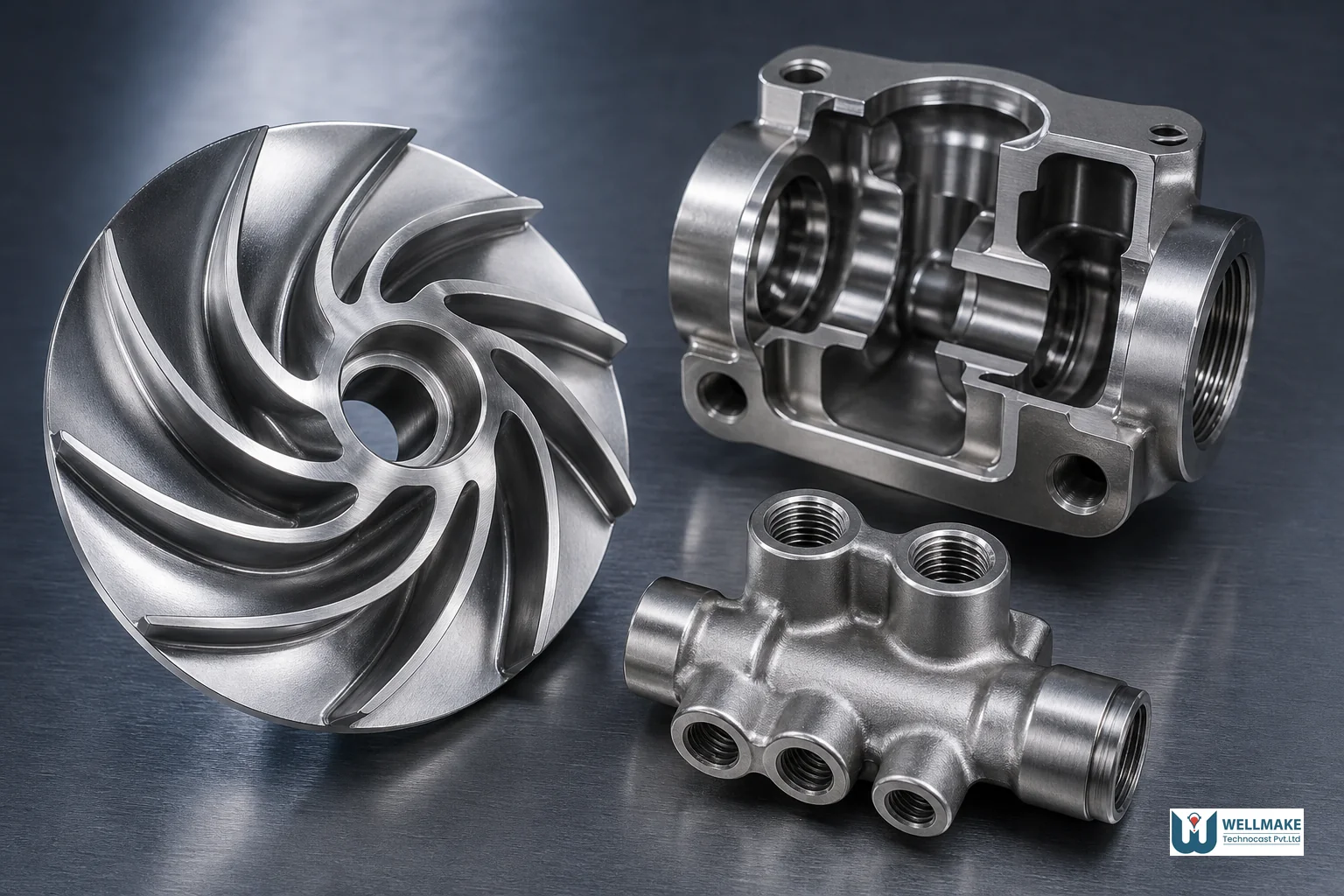
Many of the components Italian industrial manufacturers produce are not simple blocks or flanges. Pump impellers, turbine housings, hydraulic valve bodies, and oil and gas manifolds all involve internal passages, thin walls, curved surfaces, and features that are difficult or impossible to produce cleanly in sand.
What Investment Casting Can Achieve
The ceramic shell process accommodates undercuts, internal channels, thin walls down to approximately 1.5 mm, and complex three-dimensional geometries without the draft angle constraints that sand casting imposes. Cores can be incorporated to create internal passages that would otherwise require extensive drilling or EDM. The near-net-shape output means that design intent is preserved from CAD model to finished casting with minimal geometric compromise.
For Italian pump and valve manufacturers, this translates to impeller blades with precise hydraulic profiles, valve bodies with integrated internal galleries, and manifolds with multiple intersecting ports, all produced in a single casting operation rather than assembled from multiple machined pieces.
Sand Casting's Geometric Limitations
Sand casting requires draft angles (typically 1, 3°) on all vertical surfaces to allow pattern withdrawal. Internal features require sand cores, which introduce parting lines and dimensional variability. Very thin sections are prone to misrun defects. The result is that complex geometries either cannot be produced in sand, or they require design compromises, thicker walls, simplified passages, additional machining stock, that add weight and cost.
Tooling Costs, Production Volume, and Total Cost of Ownership
One of the most common misconceptions in casting procurement is treating tooling cost and piece-part price as the only variables. Total cost of ownership must include machining, scrap, inspection, and rework, and on that basis, the comparison between investment casting and sand casting often looks very different from the initial quotation.
Tooling Investment
Sand casting patterns are relatively inexpensive, a simple wooden or aluminium pattern may cost a few hundred euros. Investment casting wax dies are precision-machined metal tools that typically cost more upfront, though the exact figure depends on part complexity and size. However, investment casting dies have long service lives and produce consistent wax patterns across thousands of shots, making the per-part tooling amortisation modest at medium and higher volumes.
Per-Part Economics at Different Volumes
At very low volumes (fewer than 50 parts), sand casting's lower tooling cost can make it the more economical choice for simple geometries. As volumes increase, and particularly when the component requires significant post-casting machining in sand, investment casting's near-net-shape advantage compounds. The machining cost saved on each investment cast part offsets the higher tooling cost progressively as volume grows.
Material waste is another factor. Sand casting typically requires more machining stock, meaning more raw material is purchased and then cut away as chips. Investment casting's tighter tolerances reduce the buy-to-fly ratio, the ratio of raw material purchased to material in the finished part, which matters particularly for expensive alloys such as duplex stainless steel, Inconel, or titanium.
For a detailed analysis of how these variables interact, see our post on investment casting cost per kg drivers.
When Sand Casting Remains the Right Choice
Sand casting is still appropriate for very large, simple components where dimensional precision is not critical, large pump casings, counterweights, brackets, and structural housings where wall thickness and surface finish tolerances are generous. If the part weighs several hundred kilograms and has no complex internal geometry, sand casting's lower tooling cost and ability to handle large pours make it the practical choice.
Material Options: What Each Process Can Handle
Both processes can work with a broad range of ferrous and non-ferrous alloys, but investment casting offers more precise control over alloy composition and solidification, which matters for high-performance applications.
Investment Casting Material Range
Investment casting is compatible with carbon steel, alloy steel, stainless steel (304, 316, 316L, 17-4PH), duplex and super-duplex stainless, nickel-based superalloys, aluminium alloys, brass, and bronze. The ceramic shell process handles high-melting-point alloys that are difficult to cast in sand without defects. For Italian manufacturers in oil and gas, chemical processing, and marine applications, where corrosion resistance and mechanical performance are paramount, this alloy flexibility is critical.
Sand Casting Material Range
Sand casting handles a similarly wide range of alloys and is particularly suited to grey iron, ductile iron, and large aluminium castings. For very large components in grey or ductile iron, common in heavy machinery and infrastructure applications, sand casting remains the dominant process. The limitation is that achieving consistent mechanical properties in high-alloy steels and superalloys is more challenging in sand than in the controlled environment of a ceramic shell.
Head-to-Head Comparison: Investment Casting vs Sand Casting for Italian OEMs
The table below summarises the key differences across the criteria that matter most to Italian industrial procurement teams.
| Criterion | Investment Casting | Sand Casting |
|---|---|---|
| Dimensional Accuracy | CT4, CT6 (ISO 8062); ±0.1 mm on small features | CT10, CT13; ±1, 3 mm typical |
| Surface Finish | Ra 1.6, 3.2 µm (as-cast) | Ra 12.5, 25 µm (as-cast) |
| Geometric Complexity | Excellent, undercuts, thin walls, internal passages | Limited, draft angles required, cores add variability |
| Tooling Cost | Moderate, high upfront; long die life | Low upfront; pattern reusable |
| Post-Casting Machining | Minimal, near-net-shape output | Significant, multiple operations typically required |
| Material Waste | Low, tight tolerances reduce machining stock | Higher, more stock required for machining |
| Part Weight Range | A few grams to ~180 kg | Grams to several tonnes |
| Best For | Precision, complex, medium-to-high volume parts | Large, simple, low-precision parts |
| Alloy Flexibility | Excellent, including superalloys and duplex grades | Good, best for iron and standard steels |
Key takeaway for Italian OEMs: If your component requires tight tolerances, a good as-cast surface, complex internal geometry, or a high-performance alloy, and particularly if it will require machining in either case, investment casting almost always delivers a lower total cost of ownership than sand casting, even when the casting quotation appears higher.
Why Italian Manufacturers Are Sourcing Investment Castings from India
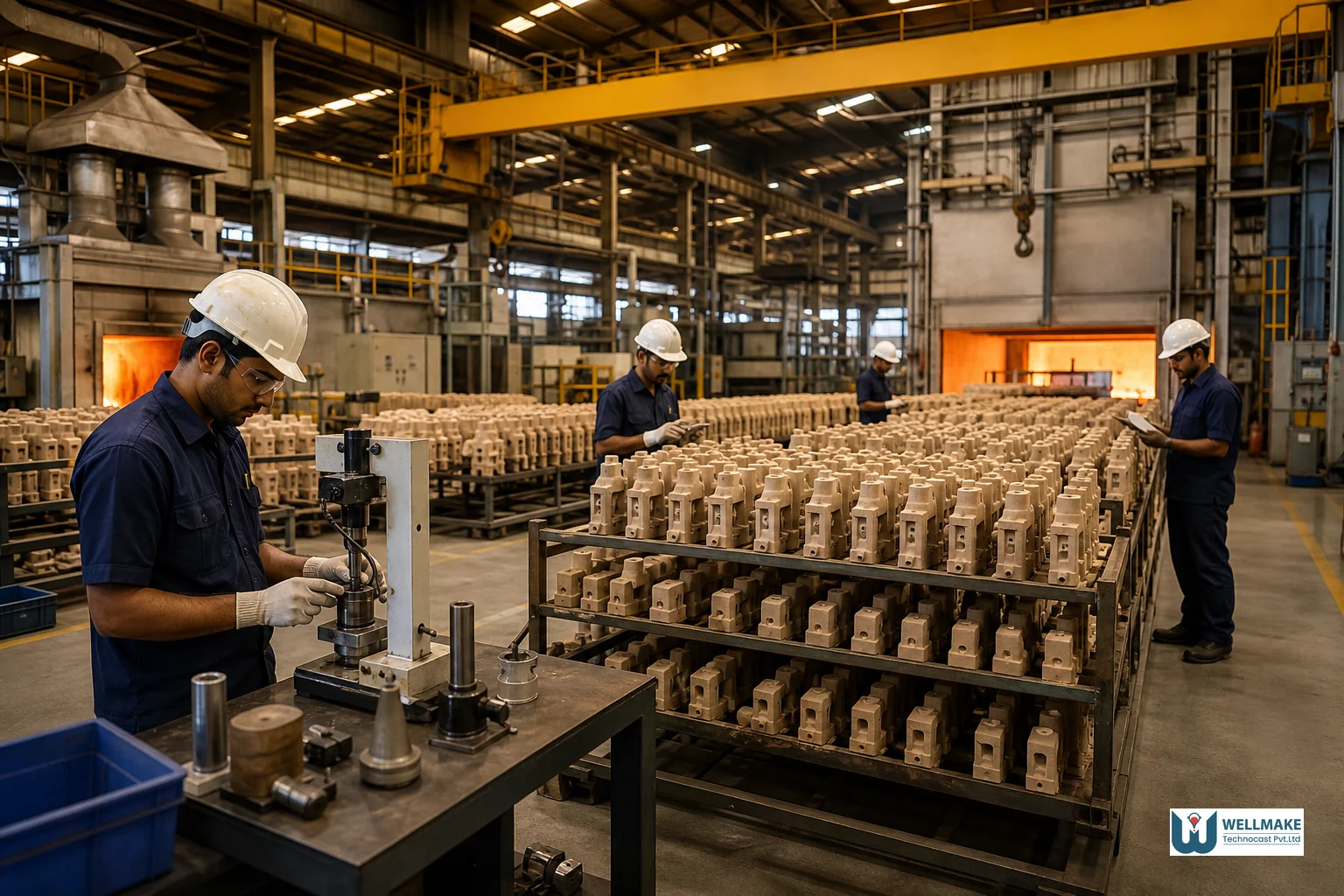
European investment casting capacity exists, but it comes at a price. Labour costs, energy costs, and overhead in Italian, German, and other Western European foundries are substantially higher than in India's established casting clusters. For Italian OEMs facing margin pressure from global competition, the arithmetic of sourcing precision investment castings from a certified Indian supplier is increasingly compelling.
Cost Competitiveness Without Quality Compromise
The concern most Italian procurement teams raise about overseas sourcing is quality consistency. That concern is legitimate, but it is addressed by certification, not geography. Wellmake Technocast, based in Rajkot, Gujarat, holds ISO 9001:2015 (quality management), ISO 14001:2015 (environmental management), and ISO 45001:2018 (occupational health and safety) certifications. These are the same international standards that European buyers apply to their domestic suppliers.
In-house quality control at Wellmake Technocast includes spectrometer analysis for alloy verification, universal testing machines (UTM) for mechanical property confirmation, hardness testing, and impact testing, providing the documented traceability that European OEM quality systems require.
Production Capacity and Single-Source Supply
With a 70 MT monthly production capacity and the ability to produce components ranging from a few grams to 180 kg, Wellmake Technocast can support both prototype development and full-scale production runs. Critically, the facility offers both un-machined and fully machined investment castings, meaning Italian buyers can receive line-ready components without managing a separate machining subcontractor in the supply chain.
This single-source capability is particularly valuable for Italian pump and valve manufacturers who currently manage separate casting and machining suppliers, each with their own lead times, quality interfaces, and logistics complexity.
Sustainable Manufacturing for European Compliance
European buyers increasingly require supply chain sustainability credentials. Wellmake Technocast's manufacturing operations incorporate renewable energy use and waste recycling programmes, supporting Italian OEMs' own ESG reporting and supply chain due diligence requirements under emerging European regulations.
For Italian manufacturers who have already evaluated the German market's approach to overseas casting sourcing, the framework is similar, and the same cost and quality logic applies. Our OEM guide for investment casting sourcing in Germany covers the qualification and logistics framework in detail, much of which translates directly to Italian procurement contexts.
Frequently Asked Questions
Is investment casting always more expensive than sand casting?
The casting quotation for investment casting is often higher than for sand casting on a per-part basis. However, when you account for the machining, finishing, and scrap costs that sand casting typically generates, investment casting frequently delivers a lower total cost of ownership, particularly for precision components in medium to high volumes. The break-even point depends on part complexity, alloy, and required tolerances.
What part sizes can investment casting handle?
Investment casting is well-suited to components from a few grams up to approximately 180 kg. It is not the right process for very large structural castings weighing several hundred kilograms or more, those applications remain the domain of sand casting or other large-format processes.
Can investment casting replace sand casting for all applications?
No. For large, simple, low-precision components, structural brackets, counterweights, large housings with generous tolerances, sand casting remains the practical and economical choice. Investment casting's advantages are most pronounced for complex, precision, medium-weight components where dimensional accuracy and surface finish directly affect function or downstream machining cost.
How do Italian OEMs qualify an overseas investment casting supplier?
The qualification process for an overseas supplier should include verification of ISO certifications, review of in-house testing capabilities, assessment of export experience and logistics track record, and ideally a first-article inspection (FAI) programme on initial production samples. Requesting material test reports (MTRs), dimensional inspection reports, and non-destructive testing (NDT) documentation on sample parts is standard practice. Our investment casting supplier guide for European OEMs covers the qualification checklist in detail.
What alloys does Wellmake Technocast supply for Italian industrial applications?
Wellmake Technocast produces investment castings in a broad range of ferrous and non-ferrous alloys, including carbon steel, alloy steel, stainless steel grades (304, 316, 316L, 17-4PH), duplex stainless steel, and non-ferrous metals including aluminium alloys, brass, and bronze. This covers the majority of alloy specifications used in Italian pump, valve, oil and gas, and industrial machinery applications.
Making the Right Choice for Your Components
The investment casting vs sand casting decision ultimately comes down to three questions: How tight are your dimensional and surface finish requirements? How complex is the geometry? And what does the total cost look like when machining and scrap are included, not just the casting quotation?
For the majority of precision components produced by Italian industrial manufacturers, pump impellers, valve bodies, hydraulic manifolds, oil and gas fittings, and engineered mechanical assemblies, investment casting delivers superior accuracy, better surface quality, and lower total cost once the full supply chain is costed. Sand casting retains its place for large, simple, low-precision applications where its lower tooling cost and ability to handle very large pours are genuine advantages.
Wellmake Technocast has been supplying precision investment castings to industrial manufacturers across Europe, North America, and the Middle East since 2005. With triple ISO certification, 70 MT monthly capacity, and full in-house machining capability, the facility is structured to serve as a reliable, single-source precision casting partner for Italian OEMs seeking to reduce total procurement cost without compromising on quality.
To see the range of precision investment cast components available across pump and valve, oil and gas, automotive, and general engineering applications, explore the Wellmake Technocast product range. To discuss your specific component requirements, tolerances, and volumes with the technical team, get in touch with Wellmake Technocast today.